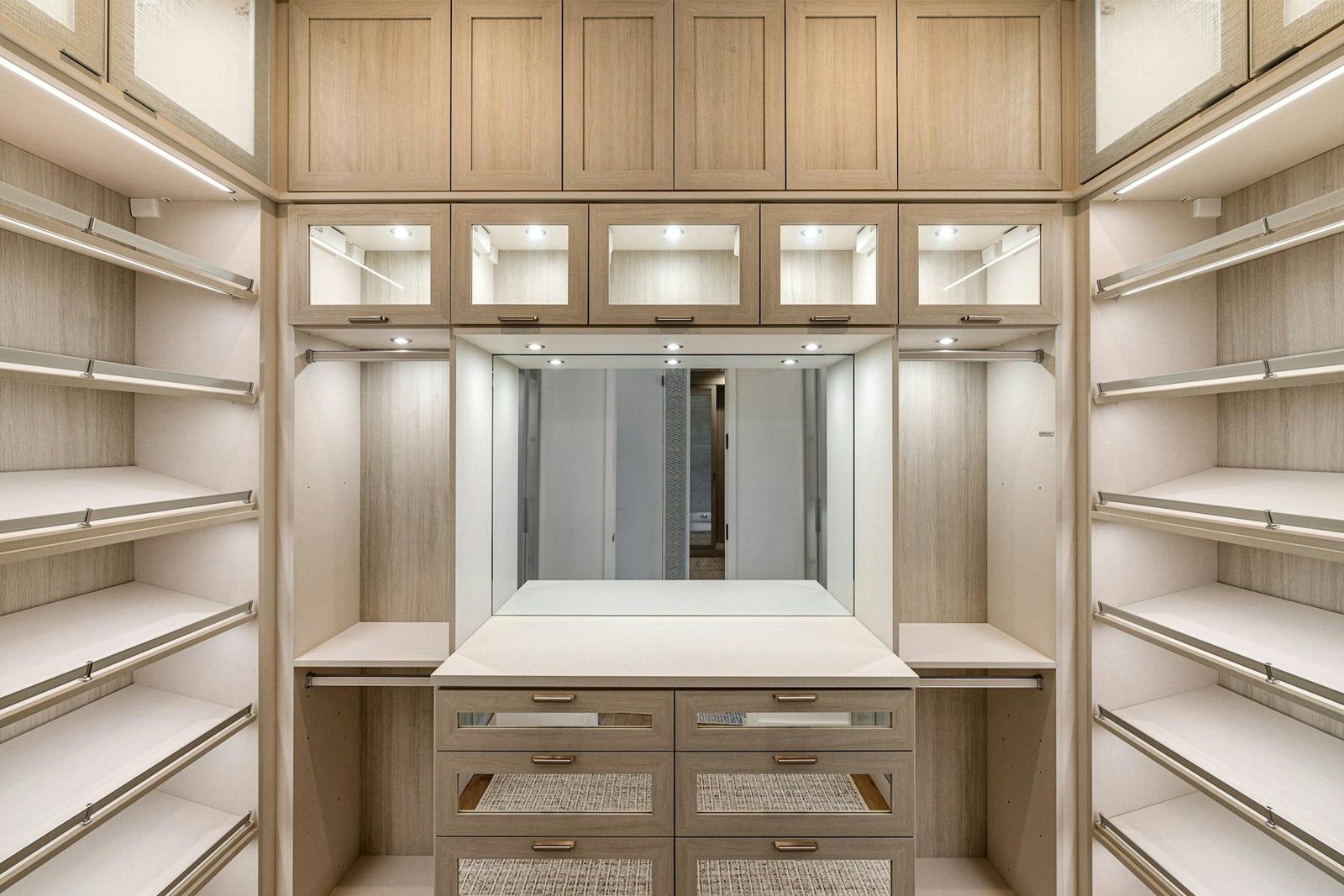
Storage Cabinets and Built-In Storage — Custom vs Off-the-Shelf
Most Adelaide homes have a storage problem in three rooms outside the kitchen — the living room (entertainment unit and bookshelves), the hallway and entry (shoes, keys, bags), and the home office (filing, desk, books). The two solutions are off-the-shelf furniture from a flat-pack retailer, or custom-built cabinetry made to the room’s specific dimensions. This guide walks the head-to-head — what custom delivers that off-the-shelf cannot, where off-the-shelf still wins on cost, and five specific room-by-room comparisons with real Adelaide pricing.
The decision is not always custom-wins. Off-the-shelf delivers acceptable results in some contexts at lower cost. The key is matching the solution to the room. We brief the trade-off at every consultation; this is the public version.
What custom delivers that off-the-shelf cannot
Five concrete advantages.
1. Wall-to-wall fit. Off-the-shelf cabinets come in standard widths (typically 600, 800, 1000, 1200, 1600mm). A 3.4m-wide alcove fits a 1600mm + 1600mm = 3.2m solution — leaving 200mm of wasted space on one or both sides. Custom builds to the exact alcove dimension, no wasted space, no awkward filler panels.
2. Floor-to-ceiling fit. Off-the-shelf cabinets are typically 1.8m, 2.0m or 2.4m tall. Adelaide rooms vary — heritage villas often have 3.0-3.6m ceilings, modern builds 2.4-2.7m. Custom cabinetry runs to the actual ceiling height, eliminating the dead-air zone above off-the-shelf furniture.
3. Internal fit-out tailored to use. Off-the-shelf comes with fixed internal layouts (typically equal-spaced shelves and one or two drawers). Custom internal fit-out matches what you actually store — drawer counts, shelf heights, pull-outs, specialty inserts (jewellery drawers, vinyl-record dividers, file-drawer systems).
4. Trim and architectural integration. Custom cabinetry connects into existing architectural features — picture rails, skirting boards, cornices, dado rails. Off-the-shelf sits in front of those features or breaks the line awkwardly.
5. Material continuity with the rest of the home. A custom-built living-room entertainment unit can use the same finish, hardware and door profile as the kitchen and laundry. Off-the-shelf rarely matches what is already in the home.
Where off-the-shelf still wins
Three contexts where off-the-shelf is the right answer.
Tenant-occupied properties. Custom cabinetry is non-removable. Tenants and short-term residents needing storage that moves with them are better served by off-the-shelf furniture.
Budget under $2,000 for a single room. Most off-the-shelf alternatives in this band — a $700-$1,500 IKEA Pax or Hemnes set for a bedroom built-in — will outperform a $2,500-$3,500 cheap-custom build. Below the custom-build minimum quality threshold, off-the-shelf is the better answer.
Temporary or transitional spaces. A spare-room office that may become a nursery, a granny-flat that may be sold, a holiday home where the cabinetry needs are uncertain — off-the-shelf accepts that uncertainty.
Outside these three cases, custom typically wins on long-term cost-per-year-of-use, fit, and sale-time appeal. A custom build that costs 50% more upfront often outlasts off-the-shelf 3:1 — net cost-per-year is lower.
Cost comparison — like for like
Comparing “$5,000 of custom” to “$5,000 of off-the-shelf” is misleading because the two deliver different things. The right comparison is delivered storage volume and finished fit.
A worked example for a mid-sized Adelaide living room (3.4m wide x 2.7m tall alcove):
| Option | Cost | Storage delivered | Fit |
|---|---|---|---|
| Off-the-shelf — 2x IKEA Hemnes 200cm + 1x 80cm sideboard | $1,800-$2,400 | ~3.2m wide x 2.0m tall = 6.4 sqm of cabinet face | 200mm gap each side; 700mm dead air above |
| Mid-custom — two-pack on Australian E0 carcass, Hettich hardware, full alcove fit | $5,500-$8,500 | 3.4m wide x 2.7m tall = 9.2 sqm of cabinet face | Exact wall-to-wall, ceiling integration, picture-rail integration |
| Premium custom — timber-veneer, full lighting, hidden integrated TV | $11,000-$18,000+ | 3.4m wide x 2.7m tall = 9.2 sqm of cabinet face | Premium finish, layered lighting, hardware to match kitchen |
Per square metre of cabinet face delivered: $375 (off-the-shelf), $750 (mid-custom), $1,500 (premium custom). Custom costs roughly 2x off-the-shelf per sqm but delivers wall-to-wall, ceiling-integrated fit and tailored internal layout that off-the-shelf cannot match.
Five room-by-room comparisons
Room 1 — Living-room entertainment unit and bookshelves
The most common custom storage project. The brief is typically a TV display zone, hidden-cable management, drawer storage for AV components, open or closed bookshelves, and either a sideboard at the base or a floating media unit.
Off-the-shelf option. IKEA Besta or Hemnes set, plus a freestanding bookcase. $1,500-$3,000 total.
Custom option. Wall-to-wall, ceiling-height entertainment unit with integrated cable management, hidden-storage drawers, glass-door display sections, integrated lighting, picture-rail integration. $6,000-$15,000 depending on spec.
When custom wins. When the alcove is non-standard width, the room has high ceilings, the brief includes hidden cable management, or the cabinetry needs to match the kitchen finish.
When off-the-shelf wins. When the cabinetry is in a guest room or rental property, when the budget is under $3,000, or when the buyer expects to move within 3-5 years.
Room 2 — Hallway storage and entry cabinetry
Shoes, bags, keys, mail, jackets — the entry to most Adelaide homes is a clutter zone with no purpose-built storage.
Off-the-shelf option. A shoe cabinet plus a coat rack plus a side console. $400-$1,200 total.
Custom option. Built-in shoe drawers (4-8 drawers, sized to fit the shoe collection), a bench seat above with hidden storage below, full-height coat hanging cabinet, key-and-mail drop drawer, hooks, mirror panel. $4,000-$10,000.
When custom wins. When the hallway is the main entry and gets daily traffic, when the family includes kids (sports gear, school bags, multiple shoe sizes), or when the entry is visible from the living room and visual neatness matters.
When off-the-shelf wins. When the hallway is a back-door entry only, when the household is small (single, couple, no kids), or when the entry is cramped and cabinetry would block circulation.
Room 3 — Home office and study fit-outs
Working-from-home has increased the home office spec dramatically since 2020. The brief is a desk, file storage, bookshelves, often a printer storage zone, and increasingly a custom-fit zone for a second monitor and ergonomic accessories.
Off-the-shelf option. A flat-pack desk plus a freestanding bookcase plus a filing cabinet. $600-$1,500 total.
Custom option. Built-in desk run with cabinetry above and below, integrated cable management, file drawers, bookshelves, optional second-desk for partner home-office sharing, soundproofing panels behind the desk, integrated lighting. $7,000-$18,000.
When custom wins. When the home office is a permanent dedicated room, when the household has two work-from-home professionals sharing a study, or when the brief includes acoustic separation for video calls.
When off-the-shelf wins. When the home office is a multi-purpose room (occasional office, occasional guest room), when the family is likely to move in 2-3 years, or when budget is under $3,000.
Room 4 — Living-room or dining-room sideboard / display cabinet
Display cabinets for collectables, glassware, art books — typically a 2.0-2.4m wide x 1.8-2.0m tall freestanding piece.
Off-the-shelf option. A freestanding sideboard, a buffet, or an antique-style display cabinet. $400-$2,500.
Custom option. Built-in display cabinet matching the rest of the home’s cabinetry, integrated lighting, glass-door display, hidden storage below for less-frequently-used items. $5,000-$11,000.
When custom wins. When the sideboard sits between two windows or in a fixed alcove, when the display item value warrants integrated lighting, or when the buyer wants total finish continuity.
When off-the-shelf wins. When the buyer expects to rearrange the room, when the piece is an heirloom or antique, or when the freestanding option allows the household flexibility to move it.
Room 5 — Bedroom built-in storage outside the wardrobe
Smaller built-ins for a bedroom — bed-side tables, a built-in vanity station, a window-seat with hidden storage, a built-in bookshelf flanking the bed.
Off-the-shelf option. Two flat-pack bedside tables and a freestanding bookcase. $300-$1,200.
Custom option. Built-in flanking units, integrated bedside lighting, drawer storage in the bed-side units, optional window-seat with storage, integrated charging stations. $4,000-$10,000.
When custom wins. When the bedroom has fixed alcoves on either side of the bed, when the room is a guest room or master suite where presentation matters, or when the brief is a window-seat or dressing-station integrated into the room.
When off-the-shelf wins. When the bedroom layout is changing (kids growing, household structure shifting), when the bedroom is a rental room, or when budget is constrained to wardrobe-only spend.
Why measurements always win
The single most common off-the-shelf failure is that standard widths do not fit standard alcoves. Adelaide homes vary widely — heritage villas have non-standard wall thicknesses, plaster walls have surface variation of 5-15mm across a 3.4m run, ceiling heights vary by 20-50mm across a single room.
Custom cabinetry handles all of this with on-site measurement at the design stage. A cabinetmaker takes the alcove dimensions, the wall variation across the run, the ceiling height variation, the skirting and architrave thicknesses, and builds the cabinetry to fit. Scribing strips (tapered filler panels) handle minor variation; the bulk of the cabinetry sits flush.
Off-the-shelf cannot handle any of this. Standard-width cabinets either fall short of the alcove (200-400mm gap on one side) or do not fit at all. Standard-height cabinets leave 300-700mm of dead air below the ceiling. The architectural features (picture rails, skirting, cornices) are bypassed, not integrated.
The exception is mid-tier off-the-shelf systems with standard fillers — IKEA’s Pax system supports filler panels in 25-50mm increments, which solves part of the width problem but not the ceiling-height problem or the architectural-integration problem.
Hardware and finish standards
Whichever option you pick, the hardware and finish drive long-term performance. Custom builds in Adelaide typically use:
- Carcass. Australian-made E0 emissions-rated 16-18mm board. Avoid imported particle-board.
- Doors. Two-pack polyurethane on MDF (paint finish), thermofoil on MDF (budget paint), timber-veneer on MDF/plywood (premium look), solid timber for bespoke heritage matching.
- Hinges and runners. Hettich or Blum soft-close. Hettich Sensys hinges; Hettich Innotech or Blum Tandembox drawer runners.
- Touch and pull hardware. Push-to-open, finger-pull profile, or visible handles depending on the visual register. Custom matches the kitchen and other cabinetry.
Off-the-shelf hardware varies widely. Premium IKEA systems (Pax, Besta) use mid-tier Hettich-equivalent hardware that performs well over 7-10 years. Budget flat-pack from non-premium retailers uses imported hardware that degrades inside 3-5 years.
For long-term durability and finish-match with kitchen and other custom cabinetry, custom wins. For 5-10 year horizons in less critical rooms, premium IKEA-tier off-the-shelf is acceptable.
Adelaide-specific design notes
A few notes for Adelaide-specific contexts:
- Heritage homes with high ceilings (3.0m+). Custom storage cabinets benefit most here — off-the-shelf leaves 700-1,200mm of dead air at the top. Custom builds floor-to-ceiling and adds 30-40% storage capacity.
- Coastal salt-air zones. Hardware degrades faster. Custom cabinetry can specify 316 stainless or solid brass; off-the-shelf is stuck with the imported chrome that came in the box.
- Apartment renovations. Apartments often have fixed concrete walls and limited ceiling penetration access for built-ins. Custom is still possible but the mounting strategy matters; consult an experienced apartment cabinetmaker.
- New-build volume housing. Most volume new-builds have standard ceiling heights (2.4-2.7m), making off-the-shelf and custom both feasible. The choice tilts on budget and finish quality.
Linking custom storage to the rest of the home
A custom-storage project rarely stands alone. Common pairings:
- Living room + kitchen — entertainment unit and kitchen built by the same cabinetmaker so the door profile, finish and hardware carry through. Read our cabinet makers vs joiners guide for the trades-specific framing.
- Whole-of-home cabinetry — kitchen, walk-in robe, laundry, living-room storage all coordinated. Read walk-in wardrobe design layouts, laundry renovation guide and pantry storage solutions for adjacent-room briefs.
- Built-in wardrobe + bedroom storage — bedroom-cabinetry coordinated as a single project. Read built-in wardrobe vs walk-in robe.
Frequently asked questions
How much more does custom storage cabinetry cost than off-the-shelf?
Roughly 2x per square metre of cabinet face for mid-tier custom over premium off-the-shelf. The full-project cost ratio is usually 2.5-3.5x because custom delivers more square metres of cabinet face per room (wall-to-wall, ceiling-height fit). Net cost-per-year-of-use can favour custom over a 10-15 year horizon.
Can I mix off-the-shelf and custom in one room?
Yes — for example, a custom-built entertainment unit with off-the-shelf bedside tables in the same bedroom. The hardware and finish need to be coordinated; otherwise the visual integration suffers.
What is the lead time on custom storage cabinets?
6 to 12 weeks from signed quote to install for most rooms, depending on door finish complexity. Two-pack and standard hardware sits at 6-8 weeks; timber-veneer with bespoke detailing can run 10-14 weeks.
Will custom built-ins add resale value?
In premium-band properties ($1.2m+) — yes, particularly in living rooms and home offices. In volume new-build ($500k-$900k) — modestly. Custom built-in storage is most valuable in heritage homes where alcoves are non-standard and off-the-shelf options visibly do not fit.
Can custom cabinets be removed if I move?
Generally no — custom built-ins are fixed to the structure. Buyers expect them to stay with the property. Some premium custom pieces (freestanding-style sideboards, bookcases) can be unscrewed and moved, but this is the exception.
What hardware should custom cabinets use?
Hettich Sensys hinges or Blum Clip-On hinges; Hettich Innotech or Blum Tandembox drawer runners, soft-close. Avoid imported flat-pack hardware in a custom build. The hardware spec should match what is in the kitchen and laundry for visual and functional consistency.
How do I choose a custom cabinetmaker?
Look for an Australian-made cabinetry build, E0 emissions-rated board, premium hardware (Hettich or Blum), and a portfolio that includes work similar to yours. Read cabinet makers vs joiners for the trade-specific decision framework.
Can I retrofit a custom built-in over an existing off-the-shelf piece?
Possible but rarely cost-effective. The off-the-shelf piece typically has to come out for the wall measurement and on-site fit. Better to plan a custom build from scratch when the off-the-shelf has reached the end of its useful life.
Get a free custom storage quote — or browse our custom cabinetry service page for the full scope of what Kitchen Fox builds across the home.