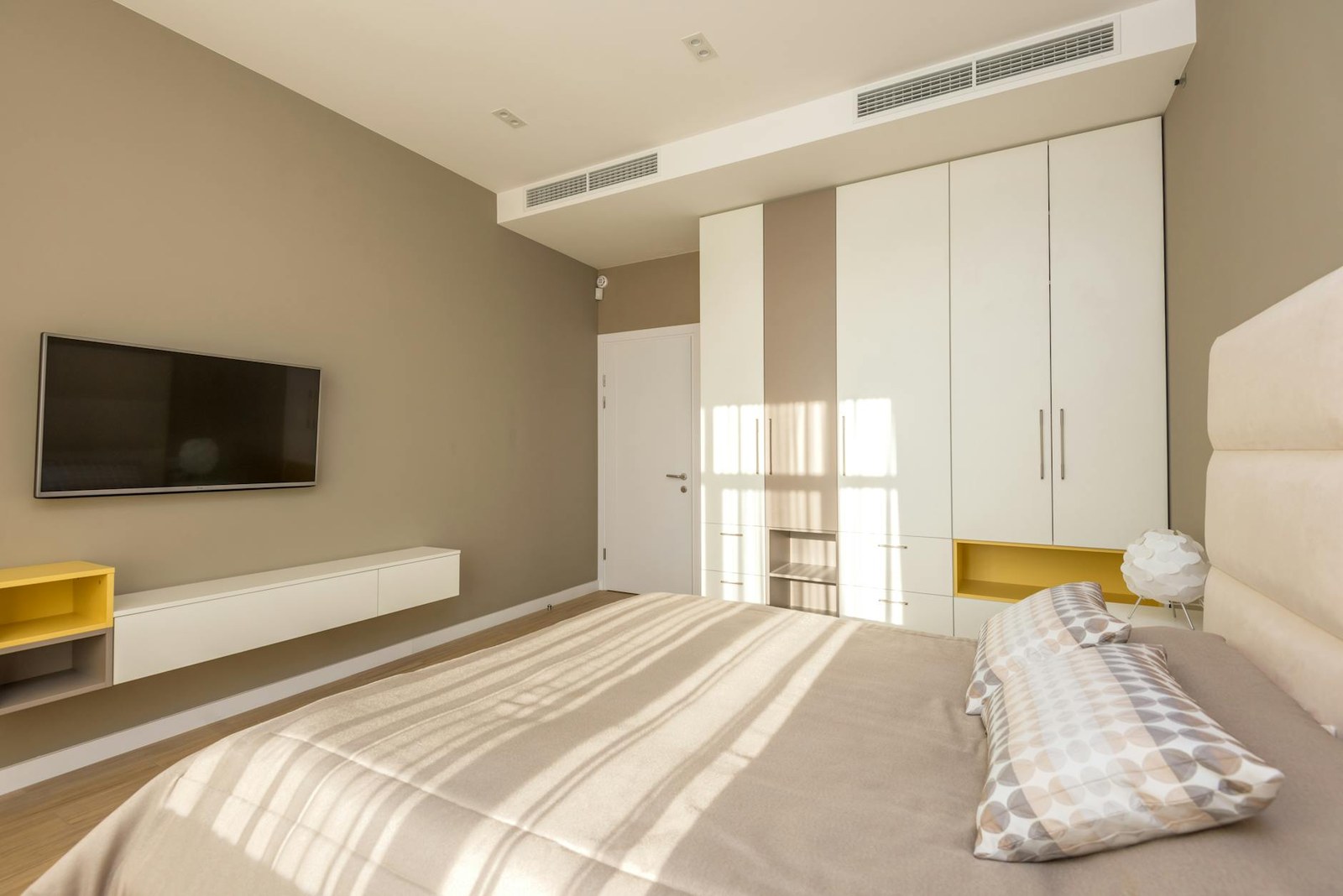
Built-In Wardrobes vs Walk-In Robes — Which Suits Your Bedroom?
The choice between a built-in wardrobe and a walk-in robe is a footprint-and-function calculation, not a style decision. Both can be built to the same cabinetry standard, the same hardware spec, and the same finish quality. What differs is the room area each one occupies, the storage volume each one delivers, and the daily-use ergonomics. This guide walks the head-to-head comparison so you can choose the right one for your bedroom — and gets specific about the cost-per-linear-metre, door styles, and internal fit-out where the trade-offs live.
We brief this decision at every master-bedroom consultation. The short version — pick the option that fits the room geometry first, then the storage volume needed, and only then the visual preference. Most Adelaide builds we see have made the visual choice first and run into footprint problems six months in.
The footprint comparison
The single biggest difference. A built-in wardrobe occupies wall space; a walk-in robe occupies room space.
| Layout | Footprint occupied | Effective hanging metres | Ratio (metres per sqm) |
|---|---|---|---|
| Built-in (single-wall, 2.4m wide x 600mm deep) | 1.4 sqm | 2.4m hanging + 4-6 drawers | 1.7 m/sqm |
| Built-in (full-wall, 4.0m wide x 600mm deep) | 2.4 sqm | 4.0m hanging + 8-10 drawers | 1.7 m/sqm |
| Walk-in (single-wall, 1.5m wide x 2.4m long) | 3.6 sqm | 2.4m hanging + 4-6 drawers | 0.7 m/sqm |
| Walk-in (galley, 1.8m x 2.4m) | 4.3 sqm | 4.8m hanging + 8-12 drawers | 1.1 m/sqm |
| Walk-in (U-shape, 2.4m x 2.4m) | 5.8 sqm | 6.0m hanging + 12-16 drawers | 1.0 m/sqm |
| Walk-in (with island, 3.0m x 3.6m) | 10.8 sqm | 6-9m hanging | 0.6-0.8 m/sqm |
Built-in wardrobes deliver more storage per square metre of floor area because there is no walking corridor — every centimetre of footprint is cabinetry. Walk-in robes need 800-1,000mm of walking corridor in front of every cabinetry run, so storage-per-sqm drops by half or more.
The trade-off — walk-in robes feel like a room. Built-in wardrobes feel like a wall.
Cost per linear metre — comparing apples to apples
The right way to compare cost is per linear metre of finished cabinetry, not total project cost. A 4-metre built-in and a U-shape walk-in with 6 metres of cabinetry should be priced per metre at similar rates if the spec is the same.
Three common Adelaide spec tiers:
| Spec tier | Two-pack on MDF (per linear metre) | Timber-veneer accent | Premium full timber-veneer |
|---|---|---|---|
| Mid-spec (Hettich/Blum hardware, two-pack doors, basic interior) | $1,400-$1,800 | $1,800-$2,400 | $2,400-$3,500 |
| Premium spec (added internal drawer banks, lighting, special-finish doors) | $2,000-$2,800 | $2,800-$3,500 | $3,500-$5,000 |
| Luxury spec (timber-veneer, full lighting, leather inserts, custom hardware) | n/a | n/a | $5,000-$8,000+ |
Cost per linear metre is broadly the same for built-in and walk-in builds in the same spec tier. The total-project difference comes from how many linear metres each layout fits — built-in wardrobes typically fit 2.4-4.0 metres into a master bedroom; walk-in robes typically fit 4.8-9.0 metres.
A working couple’s wardrobe needing 8 metres of hanging-and-folded storage:
- Built-in option — full-wall built-in (4m wide, 600mm deep) at mid-spec — $5,600 to $11,000.
- Walk-in option — galley walk-in (1.8m x 2.4m, 4.8m of bench-level rail with double-hang) at mid-spec — $9,000 to $16,000.
- Walk-in option (full storage) — U-shape walk-in (2.4m x 2.4m, 6m of bench-level rail) at mid-spec — $14,000 to $22,000.
The built-in wins on cost per metre of storage delivered. The walk-in wins on the room-feel and the ability to dress inside the wardrobe.
Door styles — built-in wardrobes only
Door style is the most visible decision in a built-in wardrobe build (walk-ins use a single entry door or open archway). The four common options:
Sliding doors
Two or three panels that slide horizontally on top and bottom tracks. Most space-efficient — no door swing.
- Pros: No swing space needed; can fill full-height openings; mirror panels add bedroom light reflection.
- Cons: Only half the wardrobe is accessible at any time (the panel that is closed covers what it covers); track maintenance over time; door alignment drift on cheap tracks.
- Cost premium: Standard. The volume choice for built-in wardrobes.
Hinged doors
Doors swing outward into the room. The traditional built-in wardrobe approach.
- Pros: Full access to all wardrobe contents at once; full visibility; cheapest door hardware; matches kitchen and other cabinetry door style.
- Cons: Needs swing space (door panel width + 100mm clear) — eats into bedroom floor space.
- Cost premium: Cheapest option per metre.
Bi-fold doors
Doors fold in pairs (panel-and-panel) on a top track. Compromise between sliding and hinged.
- Pros: Full access when fully open; less swing space than hinged; good for narrow rooms.
- Cons: Track and pivot hardware can stick or misalign; doors fold into a stack that can intrude on the wardrobe interior.
- Cost premium: Moderate ($150-$300 per linear metre over hinged).
Mirrored doors
Either sliding mirror panels or hinged doors with mirror inserts. Often combined with timber or two-pack panels for a mixed-finish look.
- Pros: Bedroom light reflection makes the room feel larger; full-length mirror means no separate dressing mirror needed.
- Cons: Mirror finger-marking; mirror panels are heavier on track hardware (cheap tracks fail faster); the mirror reflects what is in front of it — including the bed.
- Cost premium: Moderate ($200-$500 per panel over standard finish).
Internal fit-out — same spec, different geometry
The internal fit-out is where built-in and walk-in wardrobes are most similar. Both need:
- Hanging zones — short-hang (double-rail), mid-hang, long-hang in the right ratios.
- Drawer banks — typically 4-12 drawers depending on size, in 200-300mm heights.
- Open shelves — for boxes, bags, hat-and-accessory storage.
- Pull-out shelves — for jumpers, folded blankets and items that need full visibility.
- Shoe storage — angled or flat shelves, or drawers, allocated by linear metre.
- Specialty drawers — for jewellery (felt-lined, divided), watches, accessories.
The two layouts diverge on a few items.
Built-in wardrobe specifics:
- Drawers face into the bedroom (door open) — drawer pulls and finishes are visible at all times when in use.
- No island — there is no central floor area inside a built-in.
- Lighting is limited to inside-cabinet LED strips that activate when doors open.
Walk-in robe specifics:
- Drawers face into the wardrobe room — visible only when standing inside the robe.
- Optional island in larger walk-ins (Layout 5 and 7 in our walk-in wardrobe design layouts guide).
- Layered lighting (ambient ceiling + task strip + accent / vanity) is integral to the room functioning.
- Optional vanity station with mirror and seating in dressing-room layouts.
When walk-in beats built-in
Five contexts where the walk-in is clearly the better answer:
- Bedroom is bigger than 16 sqm. A large bedroom that does not need a built-in along one wall has the floor area to give 4-6 sqm to a walk-in without compressing the bed-and-living space. The walk-in adds a room-feel that a built-in cannot.
- Couple sharing storage. A couple needing 8+ metres of effective hanging benefits from a U-shape or galley walk-in. Two parallel walls of cabinetry inside a walk-in is more usable than a 4-metre built-in trying to do the same job.
- Premium master-suite design. Eastern-suburbs and Adelaide Hills builds in the $1.5m+ price band — buyers expect a walk-in. Resale value is sensitive to the walk-in presence.
- Dressing-room function. Where the brief includes a vanity station, full-length mirror, jewellery storage and a place to dress — the walk-in is the only option. A built-in cannot host a vanity or seating.
- Master-bedroom-extension renovations. Where the renovation is bumping out the master suite into a rear yard, the extra footprint is most efficiently allocated to a walk-in with adjacent ensuite.
When built-in beats walk-in
Five contexts where the built-in is the better answer:
- Bedroom is under 14 sqm. A small bedroom cannot give up 4 sqm to a walk-in without compromising the bed and circulation space. A full-wall built-in keeps the room functional.
- Heritage cottage and 1900s-1940s housing stock. Original master bedrooms in heritage homes are typically 11-13 sqm — too small for a walk-in. A floor-to-ceiling built-in along one wall is the only option.
- Apartment master bedrooms. Apartments rarely have the floor area for a walk-in. Built-in is the volume choice for apartment renovations.
- Storage-density priority. When the brief is “fit the maximum storage in the minimum footprint” — built-in delivers 1.7 metres of storage per square metre of floor; walk-in delivers 0.7-1.1 metres.
- Budget-constrained renovation. A built-in delivers comparable storage at lower total project cost because there are fewer linear metres to fit out.
The hybrid option — built-in with a small walk-in
Rather than a strict either-or, some Adelaide bedrooms support a hybrid layout:
- Reach-in walk-in — a shallow walk-in (1.5m x 2.0m) carved off the bedroom with floor-to-ceiling cabinetry on three walls and a doorway opening. Smaller than a full walk-in, less wall-occupation than a full-wall built-in. Cost band $5,000-$11,000.
- Built-in plus internal vanity — a built-in wardrobe with a recessed vanity station between two cabinetry runs. Adds dressing-room function to a built-in layout. Cost premium $1,500-$3,500.
- Bedroom-side walk-in (open robe) — Layout 8 from our walk-in wardrobe design layouts guide. A walk-in carved off the bedroom with no door, blending into the bedroom. Reads as built-in but functions as walk-in.
These hybrids work well where the bedroom is mid-sized (14-18 sqm) and a strict choice between full-wall built-in or full walk-in feels like the wrong fit.
Resale impact
Resale value implications depend on the property segment.
Volume new-build (north and south Adelaide, $500k-$900k band). Built-in robes are expected and meet buyer expectations. Walk-in robes add modest value uplift. The marginal cost of upgrading a built-in to a walk-in is rarely recovered in resale at this price point.
Mid-tier eastern-suburbs and inner-city ($900k-$1.5m). Buyers expect at least one walk-in robe in the master. Heritage cottages with built-in only meet the floor; villa renovations with walk-in robes often outperform on resale.
Premium ($1.5m+). Buyers expect a walk-in plus dressing-room potential. Built-in only is a missed-opportunity at this price band. Master walk-in plus ensuite is non-negotiable in $2m+ stock.
Apartment ($400k-$1.0m). Built-in is the volume expectation. Walk-in adds value only in larger 2-and-3 bedroom premium apartments where the floor plan supports it.
Build quality — the same standards apply
Whichever layout you pick, the cabinetry standards are the same:
Carcass. Australian-made E0 emissions-rated 16mm or 18mm board. Avoid imported particle-board carcass. Do not skimp here — wardrobes hold clothing for 10-20 years, and budget board off-gases formaldehyde for years and de-laminates within five.
Doors. Two-pack polyurethane on MDF (paint finish), thermofoil on MDF (budget paint finish), timber-veneer on MDF or plywood (premium look), or solid timber for bespoke heritage matching.
Hinges and runners. Hettich Sensys or Blum Clip-On hinges; Hettich Innotech or Blum Tandembox drawer runners with soft-close. Avoid imported flat-pack hardware in master-bedroom wardrobes.
Internal fit-out. Specify the drawer count, shelf count and hanging-zone breakdown at the design stage — this is where most renovations under-spec the build and end up with shelves where drawers should be.
The build quality should match the kitchen if both are renovated together. Read our guide to laundry renovation and pantry storage solutions for what a coordinated whole-of-home cabinetry build looks like.
Adelaide-specific design notes
A few notes for Adelaide-specific contexts:
- Heritage villas with high ceilings (3.0m+). Built-in wardrobes in heritage rooms can use the full ceiling height — no air gap above. Adds a metre of effective storage per linear metre of cabinetry.
- Coastal salt-air zones. Wardrobe hardware corrodes faster in salt-air homes. Specify 316 stainless or solid brass hardware in coastal builds.
- Hills cooler-climate homes. Wool storage matters more — specify cedar-lined drawer inserts (natural moth deterrent) in hills builds.
- New-build floor plans. Most current Adelaide volume new-builds carve a 2.4m x 1.8m walk-in robe off the master and a 2.4m run of built-in along one wall. The architect has decided the footprint; you decide the cabinetry spec.
Frequently asked questions
Are walk-in robes worth the extra cost over built-ins?
In premium-band Adelaide property ($1.5m+) — yes; resale value supports the spend. In mid-tier ($900k-$1.5m) — yes if the bedroom geometry supports a walk-in, otherwise a high-spec built-in is fine. In volume new-build ($500k-$900k) — usually no; built-in delivers the same buyer-expected utility at lower cost.
What is the minimum room size for a walk-in robe?
3.6 sqm (Layout 1 single-wall) is the absolute minimum for a walk-in. Below that you are looking at a deep built-in robe with a doorway, not a true walk-in. The mid-tier Adelaide build sits at 4.3-5.8 sqm (galley or U-shape).
How much does a built-in wardrobe cost in Adelaide?
Cost bands run from $3,500 (basic two-pack 2.4m wide) up to $25,000 (full-wall premium timber-veneer with luxury internal fit-out). Most Adelaide mid-tier builds sit in the $5,500-$11,000 band — full-wall two-pack with Hettich or Blum hardware and a full internal fit-out.
Sliding doors or hinged doors on a built-in?
Sliding if the bedroom floor space is tight or if the wardrobe is full-height (over 2.4m tall). Hinged if you want full simultaneous access to all wardrobe contents and the room can take the door swing. Bi-fold is a middle option. Mirrored sliding doors add bedroom light reflection.
Can I convert an existing built-in into a walk-in?
Sometimes. Possible if the bedroom floor area allows the walking corridor and there is a logical wall to put a doorway. Usually requires structural change and is best done as part of a full master-suite renovation. We brief feasibility at consultation.
Do walk-in robes need a door?
Typically yes — a door provides acoustic separation, dust control and a private dressing space. Some Adelaide builds use a curtained or open archway in lieu of a door for an open feel; this works in low-traffic master bedrooms where dust and acoustic separation are not concerns.
What internal fit-out do I need to specify?
Hanging-zone breakdown (long-hang, mid-hang, double-hang ratios), drawer count and heights, open and pull-out shelf count, shoe storage allocation, specialty drawers (jewellery, accessories), and lighting layers. Specify in linear metres at the design stage.
What is the most common built-in wardrobe regret?
Cutting drawer count to save cost. Drawers are more expensive per linear metre than shelves but vastly more functional for folded clothing. The fix is hard once the cabinetry is built — replacement requires re-doing the whole carcass. Spend on drawers at the design stage.
Get a free wardrobe quote — or read walk-in wardrobe design layouts for the eight working walk-in layouts and what each one costs.