Pantry Storage Solutions That Make a Real Difference
Most Adelaide pantries fail the same way — fixed shelves at fixed heights, items stacked behind items, the back of the pantry unreachable. The fixes are not exotic, but they need to be built into the cabinetry at design stage rather than retrofitted with plastic baskets later. This guide walks the storage solutions that make a working pantry — pull-outs versus shelves versus drawers, the container systems that actually function, door-mounted storage, the lighting that makes a deep pantry usable, step-shelving for tall pantries, and the choice between an in-cabinet pantry and a walk-in.
The right pantry storage starts with three questions — what do you actually store, how often do you reach for each item, and what is the geometry of the space? We brief these at consultation; this article is the public version of the brief.
Pull-outs vs shelves vs drawers — the trade-offs
Three storage formats. Each one suits different items and different access patterns.
Pull-outs (the volume choice)
Pull-out shelves on full-extension drawer runners. The shelf slides out into the room, every item visible from above, nothing stuck at the back.
- Pros: Full access to every item; no items hidden at the back; works for tall and short items; visibility is excellent at any height (because you pull the shelf to you).
- Cons: Costs more per linear metre than fixed shelves; load capacity per pull-out is finite (typically 25-40kg per shelf depending on hardware spec).
- Best for: Daily-access items — cans, jars, packets, bottles. The mid-tier Adelaide spec puts pull-outs across most of the pantry.
- Cost premium: $200-$400 per pull-out unit on top of fixed-shelf cost.
Drawers
Side-extending drawers with full-extension runners. Items visible from above when the drawer is open, drawer fronts contain items on the sides.
- Pros: Items contained on all sides — no spill-out; visibility from above is excellent; works well for grain, pasta, cereal, baking storage.
- Cons: Most expensive format per linear metre; less efficient for tall bottles and packets that exceed drawer height; requires more cabinetry depth.
- Best for: Loose-stored items (rice, flour, pasta), root vegetables (potatoes, onions in mesh), and items where containment matters (snack packets, cereal bags).
- Cost premium: $400-$800 per drawer unit.
Fixed shelves
Traditional pantry shelving — fixed shelves at fixed heights, typically 250-400mm apart. Items reached from the front; back items hidden behind front items.
- Pros: Cheapest format; most storage per linear metre on paper; suits very tall items (cereal boxes, tall bottles) and bulk storage (sacks of flour).
- Cons: Back items are functionally invisible and rarely used; rotation discipline is required to use stock evenly; access drops dramatically below knee height and above shoulder height.
- Best for: Bulk storage in walk-in pantries (lower shelves for sacks, top shelves for backup stock), and tall items that do not fit pull-outs or drawers.
- Cost: Cheapest format — base cabinetry only.
The working ratio for an Adelaide kitchen pantry
Most well-functioning pantries we see in Adelaide kitchens land near these ratios:
- 40-50% pull-outs — the daily-access middle band of the pantry (waist-to-chest height).
- 20-30% drawers — the lower-third band (knee-to-waist height) for loose-storage and grain items.
- 20-30% fixed shelves — the top band (above shoulder height) for bulk and infrequent items.
- 0-10% door-mounted storage — spice racks, sauce-bottle storage on the inside of the pantry door (when door geometry supports it).
A 600mm-wide x 2,400mm-tall pantry cabinet at this ratio runs roughly 4-5 pull-outs in the middle, 2-3 drawers below, and 2-3 fixed shelves above. Cost band $2,800-$4,500 for the internal fit-out (excluding cabinetry carcass).
Container systems that actually work
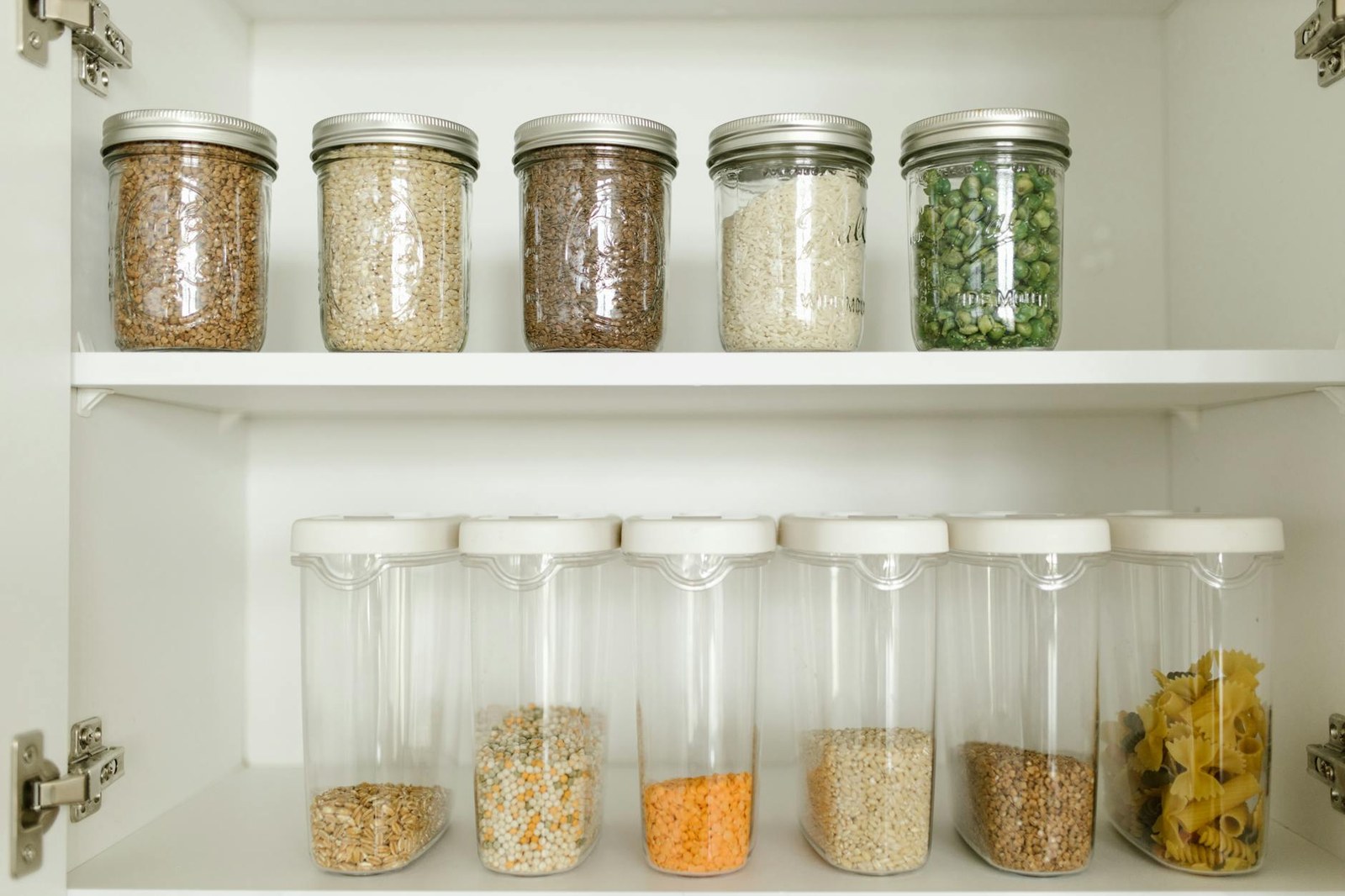
A pantry full of brand-name packets is visually noisy and wastes space — packet sizes do not nest, and the back of the pantry fills with half-finished bags. Container systems fix the visual and the storage efficiency, but only some systems work in practice.
What works
Square or rectangular airtight containers in 2-3 standard sizes. Square containers nest cleanly and use the full pantry depth. Choose 2-3 standard sizes and stick to them — buying mismatched container sets defeats the storage gain. Common working sizes — 1L, 2L and 3.5L for grain and pasta; 500ml and 1L for spices and dry goods.
Glass or BPA-free polypropylene containers. Glass shows contents at a glance and resists staining; polypropylene is lighter and cheaper. Avoid imported soft-plastic containers that yellow under fluorescent and LED light over time.
Stackable containers with airtight lids. Stack 2-3 high in pull-outs without sacrificing access. The lid mechanism matters — clip-lids fail faster than screw-or-press-lock lids; hinged-lid containers work well but need a flat surface to seal.
Modular drawer dividers. Inside a pantry drawer, dividers (timber or polypropylene) keep packets separated and visible. Adjustable dividers beat fixed ones because pantry contents change over the year.
What does not work
Open baskets without lids. Dust and ant access. Adelaide pantries get summer ant pressure (especially in older homes); lidded containers are non-negotiable for grain and dry goods.
Decorative jars without an airtight seal. Pretty on a shelf; useless for actual storage. Items go stale faster, and humidity ingress through a cork lid spoils flour and grain in 4-6 weeks.
Mismatched leftover containers. A pantry full of takeaway containers and brand-name bottles is the same problem as no containers at all. Pick a system; commit to it.
For homes that store bulk grain or flour (sourdough bakers, gluten-free families), a dedicated grain-storage drawer system with 5-10kg airtight containers makes sense — but only if the pantry is built deep enough (450-500mm internal depth) to accommodate the larger container size.
Door-mounted storage
The inside face of a pantry door is rarely used and is one of the highest-value storage zones if the geometry allows.
Spice rack on door. Tiered shelves sized to spice jars (60-100ml). Holds 30-60 jars on a single hinged door. Visible at a glance when the door opens. Best for daily-cooking households with extensive spice rotation.
Sauce-bottle storage on door. Single deep shelf with retainer bar — holds bottles by the neck. Useful for oil, vinegar, soy sauce, fish sauce, hot sauce.
Rack-and-clip storage for tea-towels, foils and wraps. Mounted on the door — frees up drawer or shelf space.
Limitations. Door-mounted storage works on hinged-door pantries (single-door or double-door swing). Sliding-door and pull-out pantries cannot host door storage because there is no inside-door surface. Tall sliding-door pantries trade door storage for the larger cabinet capacity behind sliding panels.
Hardware spec for door storage matters — the door hinges carry extra load. Specify Hettich or Blum hinges rated for door-mounted storage; cheap hinges sag inside 12-18 months under door-mounted spice rack weight.
Lighting in a deep pantry
A deep pantry without internal lighting is functionally a dark cave from waist height down. The fix is sensor-activated LED strip on the inside of the door frame.
Door-trigger LED strip. Activates when the pantry door opens. 3,000K (warm white) for a residential register, dimmable optional. Strip mounted along the inside of the door frame so light spreads evenly across the pantry interior. Power runs through a low-profile cable into the cabinetry behind. Cost band $200-$600 installed.
Under-shelf LED strip. For larger walk-in pantries — strip lighting under each shelf so contents are illuminated from above. Same 3,000K spec. Cost band $400-$1,200 for a full walk-in pantry.
Ambient ceiling LED. In walk-in pantries, a ceiling downlight or recessed strip provides general lighting on top of task lighting. Cost band $200-$500.
The total lighting spend for a generous pantry runs $400-$1,500 — small relative to the cabinetry cost and high impact on usability. Skipping the lighting is the most common pantry-renovation regret.
Step-shelving for tall pantries
Pantries above 2,100mm tall (volume Adelaide pantry height is 2,400mm) need a strategy for the top third — beyond easy reach without a step. Three options:
Option 1 — step-shelving (tiered angled shelves)
Inside the pantry, the upper shelves are tiered toward the front, so back items step down forward and become visible from the floor. Like a graduated grocery-store display.
- Pros: Items at the back become visible without stretching; reduces wasted air space at the top of the pantry.
- Cons: Reduces shelf depth at the rear; not suited to tall items.
- Best for: Top-third storage of medium-sized items (cans, jars, packets).
Option 2 — pull-down shelves
Mechanism that pulls the upper shelf down to chest height and back up. Premium spec.
- Pros: Items at the top become accessible without a step.
- Cons: Expensive ($1,200-$2,500 per pull-down unit); mechanism wear over time.
- Best for: Households with reach limitations; premium walk-in pantries.
Option 3 — accept the top is bulk-storage only
Treat the top third as backup-stock storage — items rotated up and down on a quarterly basis. Cheapest option.
- Pros: No engineering complexity; cabinetry cost stays low.
- Cons: Rotation discipline required.
- Best for: Volume Adelaide kitchen pantries.
The most common Adelaide spec is Option 3 with a small step-stool stored elsewhere in the kitchen. Option 1 is added in mid-tier custom pantries; Option 2 is reserved for premium and accessibility-focused builds.
Walk-in pantry vs in-cabinet pantry
Two structurally different approaches.
In-cabinet pantry — a single tall cabinet (typically 600-900mm wide, 2,100-2,400mm tall, 600mm deep) built into the kitchen run. Single or double hinged doors, pull-outs and drawers inside. Capacity 0.5-1.5 cubic metres of internal storage.
Walk-in pantry / butler’s pantry — a separate small room behind the kitchen with its own cabinetry, often a sink, sometimes a second oven. Capacity 2.5-6+ cubic metres of internal storage. Read our butler’s pantry design guide for the 12 walk-in layouts.
The choice depends on three factors:
| Factor | In-cabinet pantry | Walk-in pantry |
|---|---|---|
| Floor area available in the kitchen | Fits in 0.6-1.0m of wall run | Needs 2.5-6 sqm of floor |
| Storage volume needed | 0.5-1.5 cubic metres | 2.5-6+ cubic metres |
| Visual clutter management | Limited (cabinet doors close, but the kitchen wall has the cabinet face) | Excellent (everything is hidden behind a door to a separate room) |
| Cost | $2,500-$5,500 for the cabinet | $11,000-$35,000+ for the walk-in build |
| Best for | Apartments, smaller homes, second pantries | Family homes with serious cooking, premium kitchens |
Most Adelaide mid-tier kitchen renovations include an in-cabinet pantry as standard. About 40% of full kitchen renovations also include a walk-in butler’s pantry; over 80% of premium custom kitchens include one. The two are not mutually exclusive — a butler’s pantry plus a tall in-cabinet kitchen pantry is the premium Adelaide kitchen spec.
Choosing the right approach for your layout
A decision sequence to walk through:
- How big is the kitchen footprint? Under 12 sqm — in-cabinet pantry only. 12-18 sqm — in-cabinet pantry plus optional small walk-in. Over 18 sqm — both, with a generous walk-in.
- How much do you actually cook? Daily cooking from scratch with multiple cuisines — walk-in pantry. Mostly heat-and-eat cooking — in-cabinet only.
- Family size? Singles and couples — in-cabinet typically sufficient. Family of 4+ with school lunches and snacks — walk-in pantry pays back.
- How much benchtop clutter do you tolerate? Visual minimalists — walk-in pantry to hide small appliances (kettle, toaster, microwave). Comfortable with bench appliances — in-cabinet pantry plus open shelves works.
- Is the kitchen open-plan? Yes — walk-in pantry hides the cooking mess from the living zone. No — in-cabinet is typically enough.
If you are in the design phase of a kitchen renovation and torn between the two, the answer is usually “build the walk-in if the floor area supports it” — the marginal cost of the walk-in pays back in daily-use convenience and resale value in the $900k+ Adelaide property bands.
Adelaide-specific pantry considerations
A few notes for Adelaide-specific contexts:
- Summer ant and pantry-moth pressure. Adelaide summers bring ant pressure into kitchens, particularly in older homes. Airtight containers for grain and dry goods are non-negotiable. Pantry moths arrive in flour and grain bought in stores; freezing flour for 48 hours after purchase kills any larvae and prevents an infestation.
- Coastal salt-air zones. Pantry hardware degrades faster in salt-air homes (Glenelg, Henley, Brighton). Specify 316 stainless or solid brass hardware.
- Heritage villa pantries. Original villa kitchens often had a built-in cool-larder or scullery. Modern renovations often restore this footprint as a walk-in pantry, sometimes with the original ventilation slot retained as a feature.
- Hills and acreage. Larger food storage capacity makes sense in hills households where weekly grocery runs are less frequent — specify deeper pantry pull-outs and a chest-freezer or extra-fridge zone in the walk-in.
A note on pest pressure — homes with persistent ant or rodent pressure in or around the kitchen benefit from coordinated treatment around the renovation. Adelaide pest control technicians often treat the demolition zone before new cabinetry goes in — read more about Adelaide pest control for the treatment options that pair with a kitchen renovation.
Linking the pantry to the rest of the renovation
Pantry design is a sub-set of the kitchen renovation brief. Common pairings:
- Kitchen + walk-in pantry combo — both designed and built by the same cabinetmaker for visual continuity. Door profile, finish, hardware match across both rooms. Read butler’s pantry design ideas for the 12 walk-in layouts and kitchen renovation cost guide for the cost bands.
- Whole-of-home cabinetry — kitchen, butler’s pantry, walk-in robe, laundry all built by the same cabinetmaker. Read our walk-in wardrobe design layouts and laundry renovation guide for adjacent-room briefs.
Frequently asked questions
What is the best pantry storage system?
A working pantry uses three formats — pull-outs in the middle band (40-50% of pantry volume), drawers in the lower band (20-30%), and fixed shelves up top (20-30%). Combined with airtight containers in 2-3 standard sizes. There is no single “best system” — the right mix depends on what you store and how often you reach for it.
How much does a custom pantry cost in Adelaide?
A tall in-cabinet pantry (600-900mm wide, 2,400mm tall) with mid-spec internal fit-out (pull-outs, drawers, fixed shelves) runs $2,500-$5,500 in 2026 Adelaide pricing. A small walk-in pantry runs $11,000-$22,000. Premium walk-in butler’s pantry runs $22,000-$35,000+.
Pull-outs or drawers — which is better?
Pull-outs for daily-access items (cans, jars, packets) where you want full visibility from above. Drawers for loose items (grain, pasta, root vegetables) where containment matters. A working pantry uses both.
How deep should a pantry shelf be?
400-600mm internal depth is the volume choice for an in-cabinet pantry. Deeper than 600mm and items at the back become unreachable on fixed shelves (use pull-outs instead). Walk-in pantry shelves can go to 600-700mm deep because you can step inside the room.
Should pantry containers be airtight?
Yes for grain, dry goods, flour, sugar, pasta, cereal, snack items. The airtight seal prevents staling, keeps insects and rodents out (Adelaide summer pantry-moth and ant pressure), and stabilises moisture content. Decorative jars without airtight seals are fine for short-cycle items (lollies, rotation snacks) but not for serious storage.
How do I light a deep pantry?
Sensor-activated LED strip on the inside of the door frame — activates when the door opens. 3,000K warm white, dimmable optional. Total cost $200-$600 installed. For walk-in pantries, add ceiling ambient and under-shelf strip lighting; total $800-$2,500.
Can I retrofit pull-outs into existing pantry cabinets?
Sometimes — depends on the existing cabinet construction, internal width and door geometry. Off-the-shelf retrofit pull-outs work in standard 600-900mm wide cabinets but rarely match the build quality of full-custom internal fit-out. Best done as part of a full kitchen renovation.
What is the most common pantry storage regret?
Skipping internal lighting and skipping pull-outs in the daily-access middle band. The cabinetry was built; the lighting was not wired; the back of the pantry sits in shadow. Specify lighting and pull-outs at design stage; both are hard to retrofit cleanly later.
Get a free pantry quote — or read our butler’s pantry design guide for the 12 walk-in pantry layouts that work in Adelaide homes.