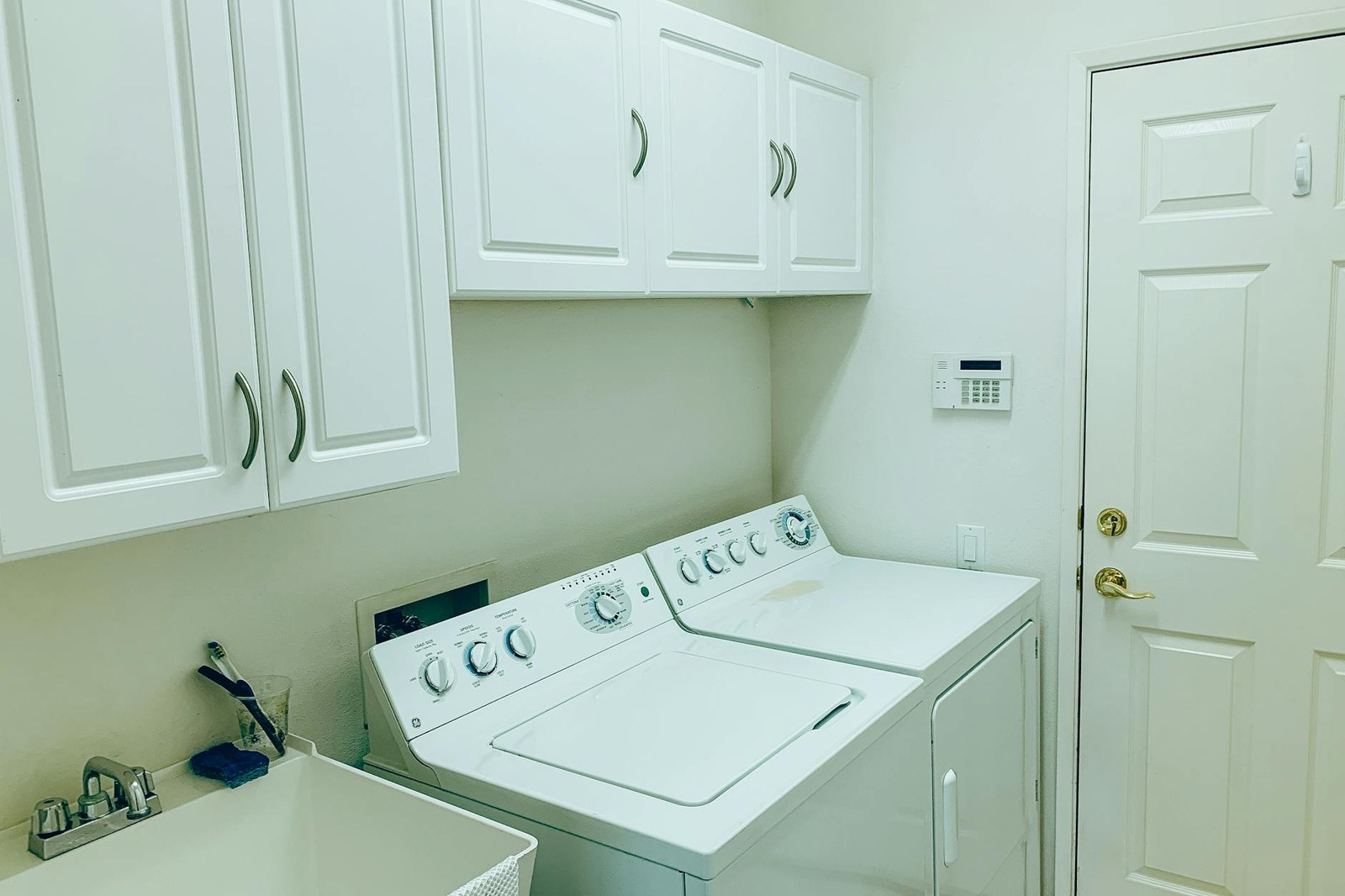
Laundry Renovation — From Cupboard to Functional Workspace
A laundry renovation is the most overlooked cabinetry project in the Adelaide home. Most laundries we audit are 1990s or 2000s builder-spec — a single tub, a stretched lino floor, a top-load washer in the corner, and a flat shelf above. The room works for one cycle of washing per week and not much more. This guide walks the layouts that turn that cupboard into a working room — what cabinetry, what bench material, what sink, what drying solution, and what each spec band costs in Adelaide for a 2026 renovation.
The laundry now performs three jobs in most Adelaide homes — washing, drying, and a long list of secondary tasks (pet bathing, mud cleanup, sports kit, ironing station, air-drying delicates). The renovation question is not “what does it look like” but “what does it have to do, and how do we fit that into the room we have?” We brief the call at consultation; this is the public version.
Laundry-as-utility vs laundry-as-room
Two starting positions:
Laundry-as-utility — a small, efficient, function-first room. Single wash and dryer cycle, basic cabinetry, single tub or sink, minimal bench. Suits second-laundry / utility-room contexts and apartments. Cost band $5,000-$12,000.
Laundry-as-room — a functional working space designed to handle the full range of laundry tasks plus secondary jobs. Generous bench, full-height cabinetry, double sink or large tub, drying rail, pet-wash station optional, ironing-station storage. Cost band $14,000-$35,000.
Most Adelaide renovations land in the second category, especially in homes with kids, pets or active outdoor lifestyles. The room is no longer treated as a utility cupboard.
Layout options
Single-wall (galley) layout
All cabinetry, bench, sink and appliance run along one wall. The simplest and most common layout for narrow laundry rooms.
- Minimum width: 2,400mm (room) with a 600mm cabinetry depth — gives 1,800mm clear walking space. Workable in spaces from 2,400mm x 1,800mm and up.
- Capacity: Washer + dryer side-by-side or stacked, plus 1.2-2.0m of bench, single sink or tub, full-height cabinetry above.
- Best for: Narrow heritage laundries, internal apartment laundries, second laundries off the garage entry.
- Cost band: Band 1 — $7,000 to $15,000.
Galley two-wall layout
Cabinetry on both opposing walls with a corridor between. Highest capacity per floor area for narrow rooms.
- Minimum size: 2,800mm wide x 2,400mm long. Corridor must be at least 1,000mm clear.
- Capacity: Washer + dryer on one wall (often stacked or column-stacked) + full-height storage on the other wall, full bench, sink, plus drying rail above the bench.
- Best for: Mid-sized laundries in heritage-villa renovations or new-build homes with a dedicated laundry room.
- Cost band: Band 2 — $12,000 to $22,000.
L-shape layout
Cabinetry on two adjoining walls. Common when a window or external door takes up the third wall.
- Minimum size: 2,400mm x 2,800mm.
- Capacity: Washer + dryer on one leg, full-height cabinetry and sink on the other leg, generous corner bench at the junction.
- Best for: Heritage rear-extension laundries, new-build laundries adjacent to a garage door or back yard access.
- Cost band: Band 2 — $11,000 to $20,000.
U-shape layout
Cabinetry on three walls. Premium spec — used when the room is large enough and the brief includes ironing station, pet-wash station and sorting bench.
- Minimum size: 3,000mm x 3,000mm.
- Capacity: Washer + dryer on one wall, full-height cabinetry on opposite wall, sorting bench on third wall, pet-wash sink integrated.
- Best for: Premium eastern-suburbs and Hills builds, mudroom-laundry combinations.
- Cost band: Band 3 — $20,000 to $35,000+.
Through-laundry (mudroom integration)
The laundry doubles as a mudroom corridor between the back door / garage and the rest of the home. Includes seating bench, hooks, shoe storage, cabinetry plus full laundry function.
- Minimum size: 2,400mm wide x 4,000mm long.
- Capacity: Mudroom zone (bench, hooks, shoes) + laundry zone (cabinetry, sink, washer, dryer).
- Best for: Family homes with kids, sports gear and high-traffic back-door access.
- Cost band: Band 3 — $22,000 to $40,000.
Cabinet spec — what good looks like
The same cabinetry standards that apply to a kitchen apply to a laundry — but the wear pattern is different. Laundries get water exposure, lint dust, chemical cleaners (bleach, dishwashing soap, stain remover) and constant door-cycling. The cabinetry needs to handle all of that.
Carcass. Australian-made E0 emissions-rated 16mm or 18mm board. Moisture-resistant edging on every cut edge that touches a wet surface (under the sink, behind the washer outlet, around the laundry tub). Standard particle-board carcass without proper edging swells and de-laminates within five years in a working laundry.
Doors. Two-pack polyurethane on MDF or thermofoil on MDF — both wipe clean. Avoid timber-veneer in a laundry; the moisture and chemical cleaners damage natural finishes. Paint-grade two-pack is the volume choice and is replaceable if a door is damaged.
Hinges and runners. Hettich or Blum soft-close. The laundry cabinet doors cycle thousands of times per year — budget hinges fail inside three to five years.
Internal layout. Pull-out laundry baskets behind one cabinet door (3 to 4 baskets, sorted by colour or family member). Pull-out bin under the sink. Internal drawers in lieu of fixed shelves wherever possible — drawers double effective storage capacity in a small laundry.
Toe-kick. Sealed toe-kick to handle minor floor flooding. Do not skimp here — a top-loader washer overflow tests the toe-kick seal directly.
Benchtop materials for a laundry
A laundry bench takes more chemical and water exposure than a kitchen bench but less heat. The material choice priorities are different.
| Material | Cost per sqm installed | Water/chemical resistance | Best application |
|---|---|---|---|
| Laminate | $150-$300 | Fair (joints fail under standing water) | Utility laundries, small footprints |
| Solid timber (oiled) | $400-$700 | Poor (needs re-oiling annually) | Avoid in laundries |
| Engineered stone (low-silica) | $600-$900 | Excellent | Mid-tier choice; matches kitchen if both renovated together |
| Porcelain | $800-$1,400 | Excellent | Premium choice; heat-tolerant for ironing-station use |
| Stainless steel | $700-$1,200 | Excellent | Ultra-utilitarian; commercial look |
Most Adelaide laundry renovations use the same benchtop material as the kitchen for visual continuity. The mid-tier choice is low-silica quartz or porcelain. Laminate is fine in compact utility laundries; avoid solid timber unless you are committed to annual re-oiling.
For ironing-station integration, porcelain wins — it handles direct iron contact without scorching, and it does not stain from spilled fabric softener or bleach.
Sink, tub and pet-wash options
The sink choice depends on what the laundry actually has to handle.
Single laundry tub — 45L or 70L, the volume choice. Suits utility laundries and smaller renovations. Stainless or fireclay. $300-$800 installed (excluding tap).
Double sink with single tub — combination layout that splits washing-machine pre-soak from general sink work. Suits family laundries handling dishes, kids’ work, pet items. $700-$1,500 installed.
Undermount stainless sink with tap mixer — modern minimalist look, easy to clean, integrates flush with stone bench. $400-$1,000 installed.
Pet-wash station — dedicated low-set tub at 600-700mm height (rather than 900mm bench height) for easy dog washing. Includes a hand-shower attachment, drain, and waterproof tile or stone surround. Adds $2,500-$6,000 to the build.
Tap choice matters. A laundry tap takes more chemical contact than a kitchen tap. Specify a solid-brass or 316 stainless body with a chrome or brushed finish — avoid budget chrome that pits under bleach exposure within two to three years.
Drying solutions
Drying is half the laundry’s job. The options:
Vented or condenser dryer. The volume choice. Stack on top of the washer (column-stack) or run side-by-side. A vented dryer needs a wall vent or external duct — non-trivial in heritage homes; condenser dryers avoid the venting problem at a higher running cost.
Heat-pump dryer. Premium spec. Slower cycle but lower running cost and less heat in the room. Worth the premium if the laundry doubles as a working room (the heat-pump dryer does not bake the rest of the room).
Combo washer-dryer. Apartment and small-laundry choice. One unit handles both jobs at the cost of slower combined cycle times and reduced capacity. Suits laundries under 2 sqm.
Drying rail or pull-out rail. Manual drying rail above the bench or pulled out from a cabinet. Air-dries delicates and saves dryer wear on knitwear. Adds $400-$1,200 to the build.
Ceiling-mounted drying rack. Pulley-operated rack that lifts laundry to ceiling height. Heritage spec; useful in winter. $300-$700 installed.
The drying combination most Adelaide builds end up with — a heat-pump or vented dryer for general use, plus a drying rail for delicates and air-dry items.
Three Adelaide laundry transformations
Three real Adelaide renovation walkthroughs to anchor the cost numbers.
Walkthrough 1 — Mark and Sarah, Mitcham, $11,500
Mark and Sarah have a 1995 brick-veneer home in Mitcham. The original laundry was a single-wall layout with a fibreglass tub and a plywood shelf — no real cabinetry. They wanted a working room that tied in with their kitchen renovation but did not need to be premium spec.
- Scope — single-wall layout, 3.0m run. Two-pack white cabinetry, low-silica quartz bench, single 70L stainless tub with chrome mixer, full-height pantry-style cabinet for cleaning storage, vented dryer stacked on washer.
- Cost breakdown — cabinetry $5,800. Bench $1,400. Sink and tap $850. Trades (plumbing, electrical) $1,800. Tile splashback $750. Project management $900.
- Total — $11,500. Five weeks from signed quote to install.
Walkthrough 2 — David and Mei, Henley Beach, $19,800
David and Mei renovated their coastal new-build laundry alongside the main kitchen reno. Brief was a galley two-wall layout with sorting capacity, drying rail and a slightly elevated spec to match the main kitchen.
- Scope — galley layout, 3.6m wide x 2.4m long. Two-pack soft-grey cabinetry, mid-spec quartz bench (matching kitchen), undermount stainless sink with brushed-nickel tap, pull-out laundry baskets (4 sorting), pull-out drying rail, heat-pump dryer column-stacked on washer.
- Cost breakdown — cabinetry $9,400. Bench $2,800. Sink and tap $1,200. Pull-outs and drying rail $1,400. Trades $2,200. Tile splashback (matching kitchen) $1,000. Project management $1,800.
- Total — $19,800. Eight weeks from signed quote to install.
Walkthrough 3 — Tom and Anna, Burnside, $32,500
Tom and Anna’s full home renovation included a U-shape laundry with mudroom integration off the garage entry. Family home with two dogs and three kids in primary school. Brief was a working laundry plus mudroom plus pet-wash.
- Scope — U-shape layout, 3.0m x 3.0m, opening through to mudroom corridor. Two-pack and timber-veneer two-tone cabinetry, porcelain bench, undermount sink, low-set pet-wash tub with hand-shower, full-height cabinetry on two walls, mudroom seat with shoe drawers and hooks.
- Cost breakdown — cabinetry (laundry + mudroom) $16,500. Bench $4,800. Sink, tap, pet-wash $4,200. Trades $3,000. Tile and waterproofing $1,800. Project management $2,200.
- Total — $32,500. Twelve weeks from signed quote to install.
Adelaide-specific laundry considerations
A few notes for Adelaide-specific contexts:
- Heritage villa rear-extension laundries — original sculleries and laundries are typically tight (1.5m wide x 2.4m long). Often makes sense to extend the laundry as part of a kitchen-and-laundry rear extension rather than crammed into the existing footprint.
- Coastal salt-air homes — Glenelg, Henley, Brighton — laundry hardware degrades faster. Specify 316 stainless or solid brass tapware. Vented dryer external duct caps need 316 stainless flap mechanisms.
- Hills bushfire zones — laundry external venting on a bushfire-rated wall needs ember-screened vent caps (BAL-12.5+ specification). Worth checking with a building surveyor at the design stage.
- New-build floor plans — most current Adelaide volume new-builds carve a 2.4m x 1.8m laundry off the garage. Volume buyers retrofitting a laundry renovation typically work within that footprint with single-wall or compact L-shape layouts.
Linking the laundry to the rest of the renovation
A laundry renovation is rarely standalone. Common pairings:
- Kitchen + laundry combo — both rooms renovated by the same cabinetmaker so the door profile, finish and hardware carry through. Read our kitchen renovation cost guide and butler’s pantry design for the parent-pillar context.
- Master suite + laundry combo — full home reno where master walk-in, ensuite and laundry are all detailed together. Read walk-in wardrobe design layouts and pantry storage solutions for adjacent-room briefs.
Where a laundry-renovation backs onto a back yard, a coordinated reno cycle often pairs with tree clearance and yard prep before the slab pour, and pre-occupation pest treatment around the demolition zone — the demo phase typically exposes ant trails and rodent harbourage that wants treating before the new room is sealed up.
Frequently asked questions
How much does a laundry renovation cost in Adelaide?
Cost bands run from $7,000 (single-wall utility laundry, two-pack, basic cabinetry) up to $40,000+ (U-shape with mudroom integration, premium spec, pet-wash). Most Adelaide mid-tier laundry renovations land in the $14,000-$22,000 band — galley two-wall or L-shape with two-pack cabinetry and quartz bench.
How long does a laundry renovation take?
5 to 8 weeks for compact utility laundries (signed quote to install). 8 to 12 weeks for mid-tier galley or L-shape. 12 to 16 weeks for U-shape and mudroom-integrated laundries. On-site install is 2 to 5 days for most layouts.
Should the laundry match the kitchen?
If both are renovated together, the door profile, finish, hardware and bench material should match for visual continuity. The functional spec inside (drawer layout, sink type, tap finish) can vary because the rooms perform different jobs.
Can I add a pet-wash station to an existing laundry?
Usually yes — a pet-wash station needs a low-set tub (600-700mm height), a hand-shower attachment, a floor drain and waterproof surround. Existing plumbing can typically be extended within 2-3m without major structural change. Adds $2,500-$6,000 to the build.
What’s the best benchtop material for a laundry?
Low-silica quartz or porcelain are the volume choices in Adelaide. Both handle water and chemical exposure. Porcelain wins for ironing-station integration. Avoid solid timber (needs re-oiling annually) and budget laminate (joints fail under standing water).
Vented dryer or heat-pump dryer in a renovation?
Heat-pump dryer if the laundry doubles as a working room — the lower heat output keeps the room comfortable. Vented dryer if the laundry is a utility-only space and external venting is straightforward. Condenser dryer is the apartment / no-vent option but runs warmer than heat-pump.
Do I need council approval for a laundry renovation?
Generally no for a like-for-like renovation within the existing footprint. Council approval applies if you extend the laundry, alter load-bearing walls, or make external alterations in a heritage character zone. We brief the planning approval question at consultation.
What’s the most common laundry renovation regret?
Skimping on cabinetry quality. A laundry cabinet cycles thousands of times per year and gets water and chemical exposure. Budget cabinetry fails inside five years. Spend on Australian-made E0 carcass with moisture-resistant edging and Hettich or Blum hardware; the cabinet outlasts the appliances.
Get a free laundry renovation quote — or browse our custom cabinetry service page for the full scope of what Kitchen Fox builds across the home.