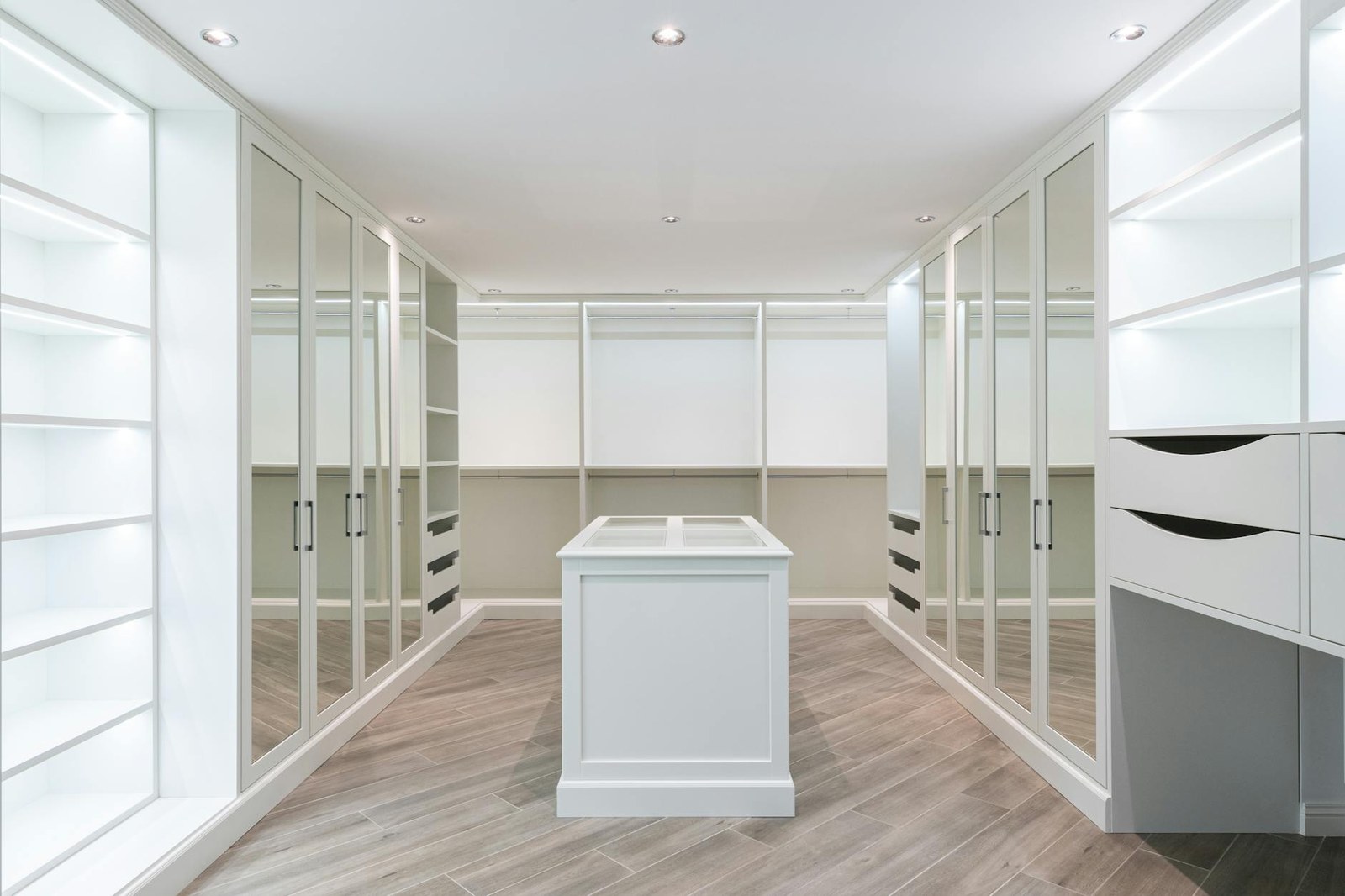
Walk-In Wardrobe Design — 8 Layouts and What Each One Costs in Adelaide
A walk-in wardrobe is a cabinetry problem before it is a styling decision. Get the layout right and the room handles a couple’s full hanging, folded, drawer and accessory load with room to dress. Get the layout wrong and you are stepping over shoes inside three months. This guide walks the eight layouts that actually function in Adelaide homes, the minimum dimensions each one needs, the maths behind hanging zones and drawer ratios, the lighting that makes a robe usable at 6am in winter, and the cost band each layout sits in for a 2026 build.
The right layout depends on three constraints — the floor area you have, how much hanging vs folding storage your wardrobe actually needs, and whether the room doubles as a dressing room. We brief these constraints at consultation; this article is the public version of that brief.
What a walk-in wardrobe needs to do
Before the layouts, three numbers worth pinning down:
- Hanging metres. A typical adult hanging wardrobe needs 1.0 to 1.5 linear metres of double-hang (short garments, two rails stacked) plus 0.5 to 1.0 metres of long-hang (dresses, coats, suits). A couple sharing a robe needs roughly 2.0 to 3.0 metres of double-hang plus 1.0 to 2.0 metres of long-hang.
- Folded storage. Drawers and shelves for jeans, t-shirts, knitwear, underwear and accessories. A working couple’s wardrobe needs 6 to 12 drawers (200-300mm tall) plus 3 to 6 open or pull-out shelves.
- Shoes. A typical Adelaide build allocates 0.5 to 1.0 linear metres of shoe shelving per person. Couples with a shoe collection blow this out — plan for 2.0 metres each if true.
Total hanging-plus-folded-plus-shoe linear metres for a couple’s wardrobe sits between 8 and 16 metres. Every layout below sizes around that envelope.
The 8 layouts
Layout 1 — Single-wall walk-in
A single run of cabinetry along one wall with a clear walking corridor in front. The simplest walk-in. Suits long narrow rooms (typical when carving a robe out of an existing bedroom).
- Minimum size: 1,500mm wide x 2,400mm long (3.6 sqm).
- Hanging metres delivered: Up to 2.4 metres double-hang (about 4.8 effective metres if double-rail).
- Folded storage: 4-8 drawers below hanging, 2-4 shelves above.
- Best for: Small robes carved from an existing bedroom corner, or new builds where the robe sits at the end of a master suite.
- Cost band: Band 1 — $4,000 to $9,000 in two-pack and Australian-made E0 carcass.
Layout 2 — Galley walk-in
Two parallel walls of cabinetry with a corridor between. Most space-efficient layout per square metre — every wall is working.
- Minimum size: 1,800mm wide x 2,400mm long (4.3 sqm). Corridor must be at least 900mm clear; 1,000mm is more usable.
- Hanging metres delivered: 4.8 metres of bench-level rail, with double-hanging brings it to 6-7 effective metres.
- Folded storage: 8-12 drawers split across both walls.
- Best for: Renovations where a small room (3 x 2.4m) becomes the robe, or new-build dressing rooms where the architect has carved a rectangle off the bedroom.
- Cost band: Band 2 — $9,000 to $16,000.
Layout 3 — L-shape walk-in
Cabinetry on two adjoining walls. Useful when one wall has a window or door that breaks an opposing run.
- Minimum size: 2,400mm x 1,800mm (4.3 sqm).
- Hanging metres delivered: Up to 4.0 metres of bench-level rail.
- Folded storage: 6-10 drawers across the two walls; the inside corner gets a corner shoe-bench or angled drawers.
- Best for: Heritage villa renovations where the existing bedroom has windows constraining the cabinetry layout.
- Cost band: Band 2 — $8,000 to $14,000.
Layout 4 — U-shape walk-in
Cabinetry on three walls, single entry. Highest hanging-and-folded capacity for a single-room footprint.
- Minimum size: 2,400mm x 2,400mm (5.8 sqm).
- Hanging metres delivered: Up to 6.0 metres of bench-level rail (with double-hanging, 8-10 effective metres).
- Folded storage: 12-16 drawers and a full shoe wall.
- Best for: Mid-tier eastern-suburbs villa renovations and new builds with a dedicated walk-in.
- Cost band: Band 2-3 — $14,000 to $25,000.
Layout 5 — Island walk-in
A central island unit (drawers, glass top, jewellery insert) inside a U or galley layout. Adds folding-and-display space to a robe with the floor area to spare.
- Minimum size: 3,000mm x 3,600mm (10.8 sqm). The island needs at least 800mm clear walkway around all four sides — anything tighter and the island becomes an obstruction.
- Hanging metres delivered: 6-9 metres around the perimeter.
- Folded storage: Perimeter drawers plus the island (typically 4-8 drawers in the island top alone).
- Best for: Premium eastern-suburbs and Adelaide Hills builds, master-suite dressing rooms in larger floor plans.
- Cost band: Band 3 — $22,000 to $40,000+ depending on island spec, glass detailing, lighting and timber-veneer.
Layout 6 — Walk-through robe (corridor)
Rather than a destination room, the robe forms a corridor between bedroom and ensuite. Cabinetry runs along both walls of the corridor.
- Minimum size: 1,800mm wide x 3,000-4,000mm long.
- Hanging metres delivered: 6-8 metres if both walls are fitted out.
- Folded storage: Drawers below hanging on both sides, shelves above.
- Best for: Master-suite layouts in new builds where the architect has stitched bed, robe and ensuite into a single suite. Also works for Hills and acreage builds.
- Cost band: Band 2-3 — $14,000 to $25,000.
Layout 7 — Dressing-room walk-in
A walk-in that doubles as a dressing room — full-length mirror, bench seat, vanity station with drawers, full-height shoe wall.
- Minimum size: 3,000mm x 3,600mm (10.8 sqm).
- Hanging metres delivered: 4-6 metres (the room budget skews to display, drawers and seating, not pure hanging).
- Folded storage: Vanity-station drawers (jewellery, watches, perfume), bench-seat drawers (shoes), full-height shoe wall.
- Best for: Premium Burnside, Tusmore, Stirling, Aldgate builds. Often added in pairs (his / hers) to luxury homes.
- Cost band: Band 3-4 — $30,000 to $60,000+ with mirror walls, lighting, integrated jewellery drawers, leather inserts and timber-veneer.
Layout 8 — Bedroom-side walk-in (open robe)
A short walk-in carved off the bedroom with no door, blending into the bedroom layout. The cabinetry has door fronts so it reads as built-in but the walk-in space sits behind it.
- Minimum size: 1,500mm x 2,400mm (3.6 sqm).
- Hanging metres delivered: 2.4-4.0 metres.
- Folded storage: 4-8 drawers.
- Best for: Smaller heritage cottages and apartments where a full walled-off walk-in is impossible but a half-walled walk-in still beats a built-in robe.
- Cost band: Band 1-2 — $5,000 to $11,000.
Hanging-zone math
Hanging zones break down by garment type. Get the ratios wrong and you end up with shirts crushed at one end and a long-hang section of wasted air space. The numbers we use:
| Garment type | Rail height above floor | Vertical space needed | Linear metre needed (1 person) |
|---|---|---|---|
| Long-hang (dresses, coats, suits) | Single rail at 1,800mm | 1,500-1,700mm vertical | 0.5-1.0m |
| Mid-hang (shirts, blouses, trousers folded over hanger) | Single rail at 1,400mm | 900-1,100mm vertical | 0.8-1.2m |
| Double-hang (shirts, polos, t-shirts on hangers, folded trousers) | Two rails — top at 1,800mm, bottom at 900mm | 850-900mm clearance per rail | 1.0-1.5m of rail (2.0-3.0m effective) |
A typical couple’s robe runs at roughly 40% double-hang, 30% long-hang, 20% drawers, 10% shoes and accessories by linear metre. Skew the percentages if you have particular wardrobes (lots of dresses → more long-hang; lots of jeans → more drawers; lots of suits and coats → more long-hang).
Drawer vs shelf ratios
Drawers cost more per linear metre than shelves. The premium is justified for daily-access folded items — t-shirts, jeans, knitwear, underwear, socks. Shelves are for occasional-access items — bag storage, sweater rotation between seasons, accessory boxes.
Working ratios for a couple’s walk-in:
- Drawers: 8-12 (split his / hers). At 200-300mm height each, total stack is 1.6-3.6m of drawer depth.
- Open shelves: 4-8 (200-400mm shelf depth). Use for boxes, hats, bags, season rotation.
- Pull-out shelves: 2-4 (in lieu of drawers for items like jumpers and folded blankets that need full visibility from above).
- Specialty drawers: 1-2 deep drawers (350-450mm) for boots, bedding, towels.
A common mistake is too many shelves and too few drawers. Folded clothing on a shelf compresses into one stack of clutter; drawers separate items. Spend on drawers; cap shelf count.
Lighting — making the robe usable at 6am
The single most overlooked element of a walk-in. Most Adelaide builds we audit have one ceiling LED downlight in the centre of the room, which casts the cabinetry into shadow and makes garment choice in low light impossible. The fix is layered lighting.
Layer 1 — ambient ceiling. Two to four downlights spread across the room, dimmable, 3,000K (warm white) for a residential feel.
Layer 2 — under-shelf strip. LED strip under each shelf and inside hanging zones. Strip lights illuminate garments without glare. Dimmable, 3,000K, sensor-activated (door-trigger for hanging zones, motion-trigger for the room).
Layer 3 — accent / vanity. A pendant or wall sconces over the vanity station in dressing-room layouts. 2,700K for a softer atmospheric register.
Layer 4 — daylight. A high window or skylight if the floor plan allows. North-facing window glass needs UV film if the room holds wool or silk for long periods (UV bleaches dark fibres).
A walk-in with all four layers wired and dimmable runs $1,500 to $3,500 in lighting on top of the cabinetry. A walk-in with one ceiling downlight is a wardrobe with shadows; a walk-in with strip lighting is a usable room.
Mirror placement
Three mirror options, in priority order:
- Full-height mirror on the back of a hinged door — most common solution. Works in single-wall, L-shape and U-shape walk-ins. Visible only when the door is closed, so does not break the cabinetry visual when in use.
- Wall-mounted full-length mirror — mounted on the only available wall in U-shape and dressing-room layouts. Frames matter — keep it minimal so it does not compete with the cabinetry detailing.
- Three-way mirror or rotating mirror — premium dressing-room only. Allows back and side views; usually wall-mounted on a swing arm.
Avoid placing a mirror directly opposite the room entry — it makes the robe feel smaller, not larger, because it doubles the corridor and the dead space.
Material and finish choices
Three working tiers:
- Two-pack polyurethane on MDF — the volume choice. Smooth painted finish in any colour, durable, easy to repaint. $700-$1,200 per linear metre.
- Timber-veneer on plywood or MDF — premium look, oak / walnut / blackbutt veneer. $1,200-$2,500 per linear metre.
- Solid timber doors — limited use cases (bespoke heritage matching). $2,500+ per linear metre.
Internal carcass should be Australian-made E0 emissions-rated board (low-formaldehyde) — non-negotiable for a room you spend time in daily and store clothes in.
Hardware drives long-term performance. Hettich Innotech or Blum Tandembox drawer runners with soft-close are the standard for Adelaide custom cabinetmakers. Hettich Sensys or Blum Clip-On hinges. Avoid imported flat-pack hardware in walk-in robes — drawers cycle thousands of times and budget hardware fails inside three to five years.
Cost bands by layout
| Layout | Two-pack mid-spec | Two-pack premium / timber-veneer accent | Full timber-veneer / island / dressing-room |
|---|---|---|---|
| 1 — Single-wall | $4,000-$6,500 | $6,500-$9,000 | $9,000-$14,000 |
| 2 — Galley | $9,000-$12,000 | $12,000-$16,000 | $16,000-$22,000 |
| 3 — L-shape | $8,000-$11,000 | $11,000-$14,000 | $14,000-$18,000 |
| 4 — U-shape | $14,000-$18,000 | $18,000-$25,000 | $25,000-$35,000 |
| 5 — Island | $22,000-$28,000 | $28,000-$40,000 | $40,000-$60,000+ |
| 6 — Walk-through | $14,000-$18,000 | $18,000-$25,000 | $25,000-$35,000 |
| 7 — Dressing-room | $30,000-$40,000 | $40,000-$55,000 | $55,000-$80,000+ |
| 8 — Bedroom-side open | $5,000-$8,000 | $8,000-$11,000 | $11,000-$15,000 |
Pricing is Adelaide 2026 fully installed including hanging rails, drawer hardware, basic LED ambient lighting (Layer 1) and standard internal fit-out. Add $1,500-$3,500 for full layered lighting (Layers 2-4); add $1,200-$3,000 for full mirror integration; add $3,000-$10,000 for island detailing in Layout 5 and 7.
Adelaide-specific design notes
A few notes on what works well in Adelaide homes specifically:
- Heritage villa robe extensions — the existing master bedroom is rarely big enough for a generous walk-in. Common solution is to bump the robe out into the rear yard as part of a kitchen-and-master extension, or to convert an adjoining small bedroom into the walk-in via a structural opening.
- Coastal salt-air zones — Glenelg, Henley, Brighton, Aldinga — robe hardware degrades faster in salt-air homes. Specify 316 stainless or solid brass hardware in coastal builds. Standard chrome chips and pits inside three to five years.
- Hills bushfire zones — non-combustible fixtures matter for cabinetry within the BAL-rated envelope. Stainless rails, metal-framed glass, cement-board carcass alternatives are sometimes specified.
- New-build floor plans — most current Adelaide volume new-builds carve a 2.4m x 1.8m walk-in robe off the master. Volume buyers upgrading to bespoke cabinetry typically retrofit Layouts 2, 3 or 4 inside that footprint.
Linking to the rest of the home renovation
A walk-in wardrobe is rarely a standalone project. It is usually rolled into a master-suite renovation, a master-bedroom extension or a full home renovation. Two common pairings:
- Master-suite combo — bedroom, walk-in, ensuite redesigned together. Walk-in cabinetry coordinates with vanity cabinetry; door profile, finish and hardware match across both rooms.
- Whole-home reno — kitchen, butler’s pantry, walk-in, laundry all built by the same cabinetmaker so the carcass spec, door profile, hardware and finish carry through. See our guide to laundry renovation and pantry storage solutions for what a coordinated build looks like.
If you are considering a built-in robe instead of a walk-in, read built-in wardrobes vs walk-in robes for the footprint-and-cost-per-metre comparison.
For premium homes, a coordinated reno cycle covers more than just the cabinetry — exterior maintenance and presentation matters too. Adelaide homeowners often pair a master-suite refresh with residential window cleaning so the natural light in a new walk-in actually reaches the room.
Frequently asked questions
What size walk-in wardrobe do I need for two people?
A couple sharing a walk-in needs at least 4.3 sqm (Layout 2 galley or L-shape minimum) to fit working hanging, drawer and shoe storage. The mid-tier Adelaide build sits at 5.8 sqm (U-shape). Anything below 3.6 sqm is functionally a deep built-in robe with a doorway, not a true walk-in.
How much does a custom walk-in wardrobe cost in Adelaide?
Cost bands run from $4,000 (single-wall, two-pack, basic) up to $80,000+ (full dressing-room with island, timber-veneer, full layered lighting). Most Adelaide mid-tier walk-ins land in the $14,000-$25,000 band — full U-shape or galley walk-in with two-pack cabinetry and Hettich or Blum hardware.
Are walk-in wardrobes worth it for resale?
Walk-in wardrobes lift master-suite presentation and add resale value in eastern-suburbs and Hills markets where buyer expectations include a master walk-in. Volume new-build markets in northern and southern Adelaide are less price-sensitive to walk-in vs built-in. The ROI is strongest in $1.2m-plus property bands.
How long does a custom walk-in build take?
From signed quote to install — typically 6 to 10 weeks for two-pack mid-spec, 10 to 14 weeks for premium timber-veneer or dressing-room layouts. Install on-site is 2 to 5 days depending on the layout complexity.
Can I retrofit a walk-in into an existing bedroom?
Yes, in three ways: (1) carve a walk-in out of one corner of an oversized master bedroom, (2) convert an adjoining small bedroom into the walk-in via a new structural opening, (3) extend out into the yard as part of a master-suite extension. Each approach has a structural-cost and council-approval profile that we walk through at consultation.
What lighting works best in a walk-in?
A four-layer setup — ambient ceiling downlights (dimmable, 3,000K), under-shelf and inside-hanging-zone LED strip (sensor-activated), accent/vanity pendant or sconces in dressing-room layouts, and a daylight source where the floor plan allows. Total lighting spend is $1,500-$3,500 on top of cabinetry.
Should I choose a built-in robe or walk-in?
Built-in robes are more space-efficient (no walking corridor) and usually cheaper. Walk-in robes give a room-feel, more total storage and resale presentation. The choice depends on the bedroom footprint and how the room is used. Read our built-in vs walk-in comparison for the side-by-side.
What hardware should I specify for a custom walk-in?
Hettich Innotech or Blum Tandembox drawer runners (soft-close), Hettich Sensys or Blum Clip-On hinges, push-to-open or finger-pull profile depending on door style. Avoid imported flat-pack hardware in walk-in robes — drawer cycles are high and budget hardware fails inside five years.
Get a free walk-in wardrobe quote — or browse our custom cabinetry service page for the full scope of what Kitchen Fox builds.