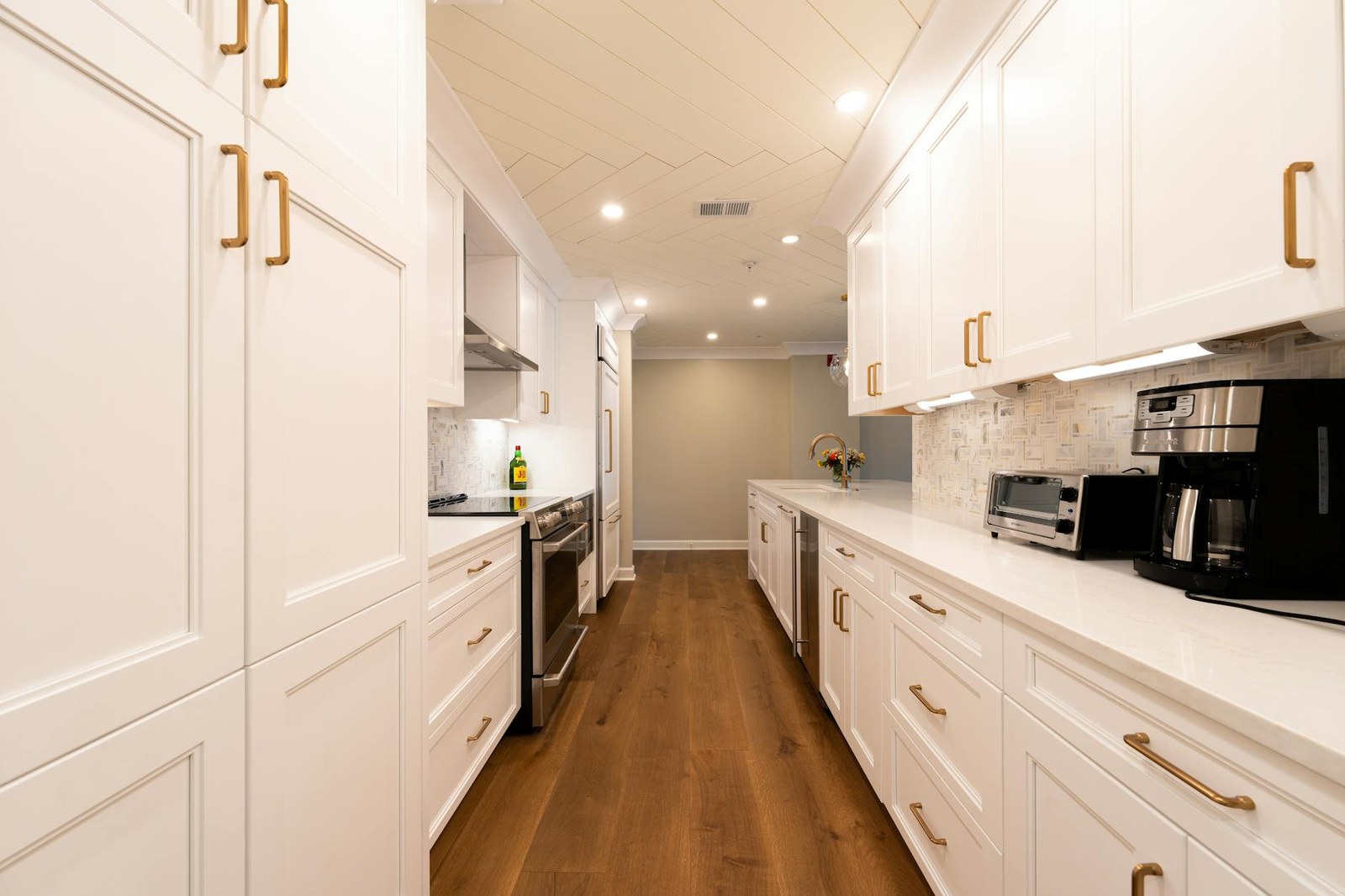
Small Kitchen Renovation in Adelaide — Cost, Layout and What’s Worth the Money
A small kitchen renovation in Adelaide — defined here as a footprint under about 12 square metres, typical of inner-city townhouses, post-war units, semis and apartments — usually costs between $15,000 and $35,000 in 2026. The middle of that range, around $22,000 to $28,000, is where most jobs land for owners who want custom cabinetry, a quartz or porcelain benchtop, new sink and tapware, and a re-thought layout that actually fits the way they cook.
That price feels high until you look at where the money goes. Cabinetry doesn’t get cheaper just because there’s less of it. The fixed costs of demolition, plumber, electrician, project management, stone templating and install are largely flat regardless of footprint. What you save on materials in a small kitchen, you give back to the per-metre setup costs. The real savings come from layout discipline, keeping plumbing in place, and not over-specifying premium where it won’t be seen.
This guide walks through what a small kitchen renovation actually costs in Adelaide, which layouts work in tight footprints, where to spend, where to hold back, and how to brief a designer so the quote you get back reflects reality rather than wishful thinking.
What “small” actually means
For renovation pricing purposes, a small Adelaide kitchen is one with under about 12 linear metres of cabinetry across all walls combined, or under about 12 square metres of floor footprint. The most common small-kitchen typologies we see are:
- The 1990s townhouse galley — two parallel runs, each 2.4 to 3.0 metres, with a passage between. Around 5 to 6 metres of total cabinetry. Often with a fixed wall-mounted oven and a single under-bench sink.
- The post-war single-fronted villa kitchen — a single L or U shape against a back wall, opening to a back room. 4 to 7 metres of cabinetry, often with a window over the sink and limited bench space.
- The unit/apartment kitchen — single-wall or compact L. 3 to 5 metres of cabinetry. Concrete slab build with services often coming up through the slab and difficult to relocate.
- The 1960s semi kitchen — narrow L or U, 4 to 6 metres of cabinetry, with a separate dining nook.
Each type has its own cost ceiling and its own savings opportunities. The townhouse galley is the most price-sensitive (because it’s usually being renovated by a first-home owner). The villa kitchen is the most price-elastic (because it’s often being opened up structurally at the same time, which inflates the total scope).
The four cost bands for small kitchen renovations
| Band | Range | Scope | Typical home |
|---|---|---|---|
| 1 — Refresh | $12,000 – $18,000 | Replacement cabinet doors, new bench (laminate or budget quartz), keep existing carcass, re-use appliances, no layout change | Tidy 1990s townhouse, low-spec rental upgrade |
| 2 — Mid-tier custom | $18,000 – $28,000 | New custom cabinetry, mid-spec quartz bench, splashback, new sink and tapware, replacement appliances, layout staying largely the same | Most owner-occupier small renos in Adelaide |
| 3 — Custom with layout change | $28,000 – $40,000 | New custom cabinetry, premium quartz or porcelain bench, splashback, integrated dishwasher, layout reworked, new electrical and plumbing runs | Inner-city villa being modernised, apartment kitchen reworked |
| 4 — Small but premium | $40,000 – $60,000+ | Full custom timber-veneer or two-pack, premium stone, integrated appliances, structural change | Eastern-suburbs unit, high-end renovation in a small footprint |
The jump from band 2 to band 3 is almost always layout-related. Move a sink, swap a cooktop wall, or open the kitchen into the dining room and you’ve added structural, plumbing and electrical scope that costs more than the cabinetry itself.
For the wider context including how a small reno compares to a mid-size full renovation, read the four cost bands explained in our main pricing guide.
Why small kitchens cost more per square metre
This is the part that surprises homeowners briefing their first quote. The dollar-per-square-metre rate is higher on a small kitchen than a mid-size one. The reasons are mechanical:
- Fixed setup costs. Demolition, waste removal, site set-up, project management, the day rate of the plumber and electrician — these are flat costs that get spread across a smaller cabinetry run. On a 5-metre kitchen, the fixed costs might be 30 percent of the total. On a 12-metre kitchen they’re 18 percent.
- Stone templating and install. A stonemason charges a minimum call-out for templating and a minimum for install. If your benchtop is 3 square metres rather than 8, you still pay close to the same site visits.
- Cabinetry minimums. Most custom cabinetry shops have a minimum order — typically around $5,000 to $7,000 for the cabinetry alone. Below that they’re losing money, so they decline or scale up.
- Project management overhead. A two-week install needs the same coordination as a four-week install. The hours don’t halve.
What this means: if you’re getting quotes back at $4,500 per linear metre on a 5-metre kitchen, that’s not unreasonable. The same custom shop quoting an 11-metre kitchen would be closer to $3,200 per metre. You’re not being overcharged — you’re paying the floor.
Layouts that work under 12m²
The four layouts that actually function in a small Adelaide kitchen footprint:
Galley — two parallel runs
The galley is the strongest performer in tight floorplans. Two parallel runs of cabinetry, with 1.0 to 1.2 metres of clearance between them, give you the most bench, storage and circulation per square metre.
What makes a galley work:
- One run carries the cooktop and oven. The opposite run carries the sink and dishwasher.
- Tall pantry and broom storage at the ends rather than the middle.
- Avoid drawers facing each other in a 1.0-metre walkway — a half-open drawer blocks the entire passage.
- Splashback continues full-height behind the cooktop only; budget tile or laminate on the sink wall.
Cost band typically 2 to 3 ($20,000 to $35,000 fully done).
Single-wall — one continuous run
Suitable for very tight footprints — apartment kitchens, studios, granny flats. A single 3.0 to 4.5-metre run carries everything. Vertical storage replaces horizontal: tall pantries, full-height microwave-and-oven towers, ceiling-height upper cabinets.
What makes a single-wall work:
- Don’t waste a square metre. Toe-kick drawers, top-of-cabinet decorative storage and full-height pantry walls all earn their place.
- An island opposite the run (if the floor allows 1.0 metre clearance) doubles your bench space cheaply.
- Splashback full-height behind the cooktop and sink, even if it’s the entire run — it’ll read cohesive.
Cost band typically 1 to 2 ($15,000 to $25,000).
L-shape — corner-based
The L is the default Adelaide townhouse and post-war semi layout. Two runs at right angles, with the corner being the most contested square metre in the kitchen.
What makes an L work:
- A corner solution that earns its keep — magic corner pull-out, lazy susan, or a corner drawer system. Don’t accept dead space behind a corner door.
- The cooktop on the longer run, sink in the corner or under a window. Keeps the work triangle tight.
- A tall pantry at one end of the longer run rather than splitting storage across the corner.
Cost band typically 2 to 3 ($20,000 to $35,000).
U-shape — three runs
The U is rare under 12m² but appears in some 1960s semis. Three runs of cabinetry, with the cook in the middle. The risk in a small U is that the bench depth eats your circulation. A U-shape kitchen with under 1.4 metres between opposite benches feels claustrophobic — the L often performs better in the same footprint.
What makes a U work in a small space:
- One leg shorter than the other two — typically the leg facing the dining or living area becomes a bar/breakfast bench at 600mm rather than 900mm.
- Pull-out drawers for the deepest cabinets (corner cupboards in a small U are unusable without them).
Cost band typically 3 ($28,000 to $40,000).
Storage tricks that pay back per square metre
In a small kitchen, every centimetre of cabinetry is contested. The storage details below add 5 to 12 percent to the cabinetry budget but move the kitchen from “compromise” to “actually works”:
- Pull-out base pantries. A 300 or 450mm wide pull-out pantry at the cooktop end carries dry goods, oils and sauces in a footprint smaller than a single drawer. Adds about $400 to $700.
- Magic corner pull-outs. A small kitchen with a useless corner is a lost cabinet. A magic corner system makes the dead 900mm by 900mm corner accessible for pots, slow cookers and bakeware. Adds about $700 to $1,200.
- Drawer-banks instead of cupboards. Drawers cost more than cupboards — about 10 to 15 percent — but recover 30 percent more usable storage in a small kitchen. Worth the cost on the run that holds plates, glasses and utensils.
- Toe-kick drawers. A flat 100mm toe-kick drawer along the entire base run holds baking trays, oven trays and serving boards that otherwise consume a full cupboard. Adds about $300 to $600 across the run.
- Wall pantries to the ceiling. A 2,400mm tall pantry uses every vertical centimetre. The top section, accessed by a stool, holds rarely-used appliances (turkey pan, slow cooker, ice cream churner). Compared to a 2,100mm pantry, the extra 300mm of height is essentially free vertical real estate.
- Cooktop drawer below. A 450mm or 600mm wide drawer directly below the cooktop holds frying pans, saucepans and sieves where they’re needed. Removes a full base cupboard from the rest of the kitchen.
These tricks are cabinetry decisions, not layout decisions. A good designer briefs them at the consultation, not as upsells later.
Where to spend in a small kitchen
In a small footprint, where you spend matters more than how much you spend. The priorities, in order:
- Cabinetry build quality. The same hinges, runners and carcass-board grade you’d specify in a 12-metre kitchen. The smaller scope shouldn’t change the spec. Hettich or Blum hardware, Australian-made E0 carcass, soft-close drawers throughout. Read the difference between cabinet builders here — cabinet makers vs joiners in Adelaide.
- Bench-top quality. A small kitchen has a small benchtop area, so the cost difference between mid-spec and premium quartz is often only $1,500 to $3,000. Spend it. The bench is the most-used surface in the home.
- Sink and tapware. A small kitchen tap gets used more, not less. A WELS 5-star pull-out mixer with a 10-year warranty pays for itself.
- Lighting. Under-cabinet LED strip plus one or two pendants over a small kitchen lifts the whole room from “compact” to “considered”. The materials cost is small ($300 to $700), the impact is large.
- The splashback behind the cooktop. Full-height stone or glass behind the cooktop is the kitchen’s hero surface in photos and in person. Invest there.
Where to save in a small kitchen
The reverse list — where pulling spend back doesn’t hurt the result:
- Appliance spec. A mid-tier oven and dishwasher will outlast the renovation cycle. Premium integrated appliances at $5,000-plus per unit are a luxury, not a quality necessity in a small kitchen.
- Splashback in invisible zones. A budget tile or laminate splashback on the sink wall (if it’s a back wall, not a focal one) is fine.
- Door finish on hidden runs. Two-pack on the front-of-room cabinets, melamine or thermofoil on the run that backs onto a hallway. Visually identical from the eye-line, $800 to $1,500 cheaper.
- Cabinet handles. A $30 handle and a $90 handle look the same from two metres away. Spend on hinges and runners, hold back on visible hardware.
- Pantry door material. If the pantry is a separate room or a tall cabinet behind a single door, the inside doesn’t need the premium finish. Standard white melamine internals are fine.
Three Adelaide small-kitchen walk-throughs
Inner-north Walkerville townhouse — band 2 ($24,000)
A 1995 two-storey townhouse, 5.4-metre L-shape kitchen against a window-and-door wall opening to a courtyard. Original kitchen: laminate doors, melamine carcass, stainless single-bowl sink, 600mm freestanding oven.
Brief: keep the layout, replace the kitchen, modernise without losing the courtyard light.
What was done:
- New custom cabinetry, two-pack matte white doors, Australian-made E0 carcass, Blum hinges and runners.
- Mid-spec quartz benchtop in dove grey, mitred edge, 6 square metres.
- Subway tile splashback to underside of upper cabinets, full-height behind cooktop.
- Replacement 600mm electric oven, induction cooktop, integrated rangehood.
- Stainless undermount double bowl sink, brushed nickel pull-out tapware.
- LED strip under upper cabinets, two pendants over the longer run.
Cost: $24,200 inc GST. Timeline: 11 weeks from signed quote.
What pulled the cost down: original layout retained, plumbing and electrical not relocated, mid-spec quartz rather than premium. Read more about the renovation timeline week-by-week.
Eastern suburbs Unley unit — band 3 ($33,500)
A 1970s ground-floor unit, 4.0-metre single-wall kitchen with no island, opening to a separate dining room.
Brief: open the wall between kitchen and dining, add an island, modernise the spec.
What was done:
- Half-height wall removal between kitchen and dining (load-bearing — required structural engineer certification).
- New 4.0-metre wall run plus 2.4-metre island.
- Custom cabinetry, two-tone (charcoal lower, oak veneer upper).
- Premium quartz benchtop with waterfall ends on island, 7.2 square metres total.
- Glass splashback full-height behind the cooktop wall.
- Integrated dishwasher, gas cooktop, electric oven, integrated rangehood concealed in upper cabinetry.
Cost: $33,500 inc GST including the structural work and certifier sign-off. Timeline: 14 weeks.
What drove cost up: structural change (engineer plus building rules consent added about $4,000), the island as a second surface, integrated appliances. Worth it for the open-plan outcome — see open-plan vs closed kitchen value analysis for the resale lens.
How to brief a quote that doesn’t blow out
The most common reason a small kitchen renovation quote escalates from $22,000 to $32,000 mid-project is brief drift — adding scope after the contract is signed. Three rules to keep the quote stable:
- Decide the layout before you sign. Don’t tell the designer “keep it as-is” then ask three weeks in if the sink can move to the window. Walk through the layout, sketch it, agree it before the contract.
- Lock the appliances at briefing. Appliances that change after cabinetry is built require door panels to be re-cut, voids to be re-sized, plumbing and electrical to be re-positioned. A $400 oven swap can become a $2,000 cabinetry rework.
- Specify the splashback before stone is templated. Splashback decisions affect bench-edge finish, upstand height and tile-grout to bench-edge clearances. Decide tile vs glass vs stone at briefing.
What to bring to a small-kitchen consultation:
- A rough floor sketch with measurements (or photos with a tape measure visible in each one).
- Photos from each corner of the existing kitchen.
- Inspiration images you’ve actually saved (real images, not Pinterest “ideal” boards).
- Your appliance preferences if you’ve decided.
- A budget band — even rough is enough. “I want it under $25,000” lets the designer steer the spec early; “I’m not sure” pushes the design toward band 3 by default.
Get a small-kitchen quote → or read how to find a renovation contractor you can trust before you start interviewing.
Cross-trade work to plan around the renovation
A small-kitchen renovation is the right time to coordinate two adjacent jobs:
- Window cleaning and prep on adjoining glazing. Townhouse and unit small kitchens often have window-over-sink glazing that’s been ignored for years. Booking residential window cleaning in Adelaide ahead of the bench install gets the glazing handled before the new stone is in place — much harder afterwards.
- End-of-build pest treatment. Demolition exposes void spaces, plinth gaps and slab penetrations that can be ant or rodent harbourage. A treatment between demolition and new-cabinet install seals the voids before they’re closed up. Adelaide pest control handles this as a single-visit treatment if the existing cabinetry shows trail signs.
Both are small line items ($200 to $500 each) that are dramatically cheaper to do mid-renovation than retrofit afterwards.
Is a small kitchen renovation worth it?
The honest answer for most Adelaide small-kitchen owners is yes, with one caveat. A well-executed small kitchen renovation in band 2 ($22,000 to $28,000) typically recovers 65 to 80 percent of cost in resale value uplift if the home is sold within five years — and delivers daily quality-of-life improvement that’s hard to put a number on. Read the full ROI analysis for the resale lens.
The caveat: if your home is in a price-sensitive segment (sub-$600,000 inner-north or outer-southern stock), don’t over-spec into band 3 or 4. The market won’t pay for premium cabinetry on a $580,000 townhouse. Match the spec to the home.
Frequently asked questions
What’s the minimum realistic budget for a small kitchen renovation in Adelaide?
About $15,000 in 2026 for a band 1 refresh (replacement doors, new bench, retained carcass and appliances). Below $15,000 you’re looking at a paint-and-replace-doors job rather than a renovation. A full custom small-kitchen renovation realistically starts at $18,000 once new cabinetry, new bench, splashback and tapware are included.
Do I need development approval for a small kitchen renovation?
Not for most renovations that retain the existing footprint and don’t alter load-bearing walls. Replacing cabinetry, benchtops and appliances inside an existing kitchen footprint is exempt from development approval in most Adelaide LGAs. If you’re removing a wall, extending the footprint, or working on a heritage-listed property, approval applies — your designer should confirm at the consultation.
How long does a small kitchen renovation take?
Refresh jobs (band 1) — 5 to 7 weeks from signed quote. Mid-tier custom (band 2) — 9 to 12 weeks. Custom with layout change (band 3) — 13 to 16 weeks. Most of the duration is cabinetry build and stone templating, which are the same regardless of footprint size.
Can I live in the home through a small kitchen renovation?
Yes, almost always. Expect the kitchen to be unusable for one to two weeks during demolition and install. Most owners set up a temporary kitchen in the dining room — kettle, microwave, electric frypan, fridge moved out of the kitchen. We brief the temporary kitchen at the project-planning stage so it’s not a last-minute scramble.
Is it cheaper to keep the existing layout?
Yes, significantly. Keeping the sink, dishwasher and cooktop in their existing positions saves $2,500 to $6,000 in plumbing, electrical, structural and certification costs compared to relocating them. In a small kitchen, the budget difference between band 2 (layout retained) and band 3 (layout changed) is largely the cost of moving services.
Are flat-pack kitchens worth it for a small renovation?
Sometimes. Flat-pack works for tight-budget refresh-tier jobs where carcass quality is less critical. It struggles in custom-fit small kitchens where cabinet sizes need to flex by 50mm or 100mm to fit walls that aren’t square. Read the full breakdown — flat pack kitchens — when they work and when to walk away.
Should I integrate the dishwasher in a small kitchen?
If your budget reaches band 3, yes — an integrated dishwasher reads as cabinetry and recovers a visual line in a small space. In band 2, a freestanding dishwasher with a stainless or panel-matched front is a fair compromise that saves about $800 to $1,400 against a fully integrated unit.
What’s the worst false economy in a small kitchen renovation?
Cabinetry build quality. A $2,000 saving on a budget cabinetry build becomes a $6,000 regret three years later when hinges fail, drawers stop closing, and replacement is the only fix. The same Hettich or Blum hardware that goes in a 12-metre kitchen should go in a 5-metre kitchen — the smaller scope doesn’t change the spec.