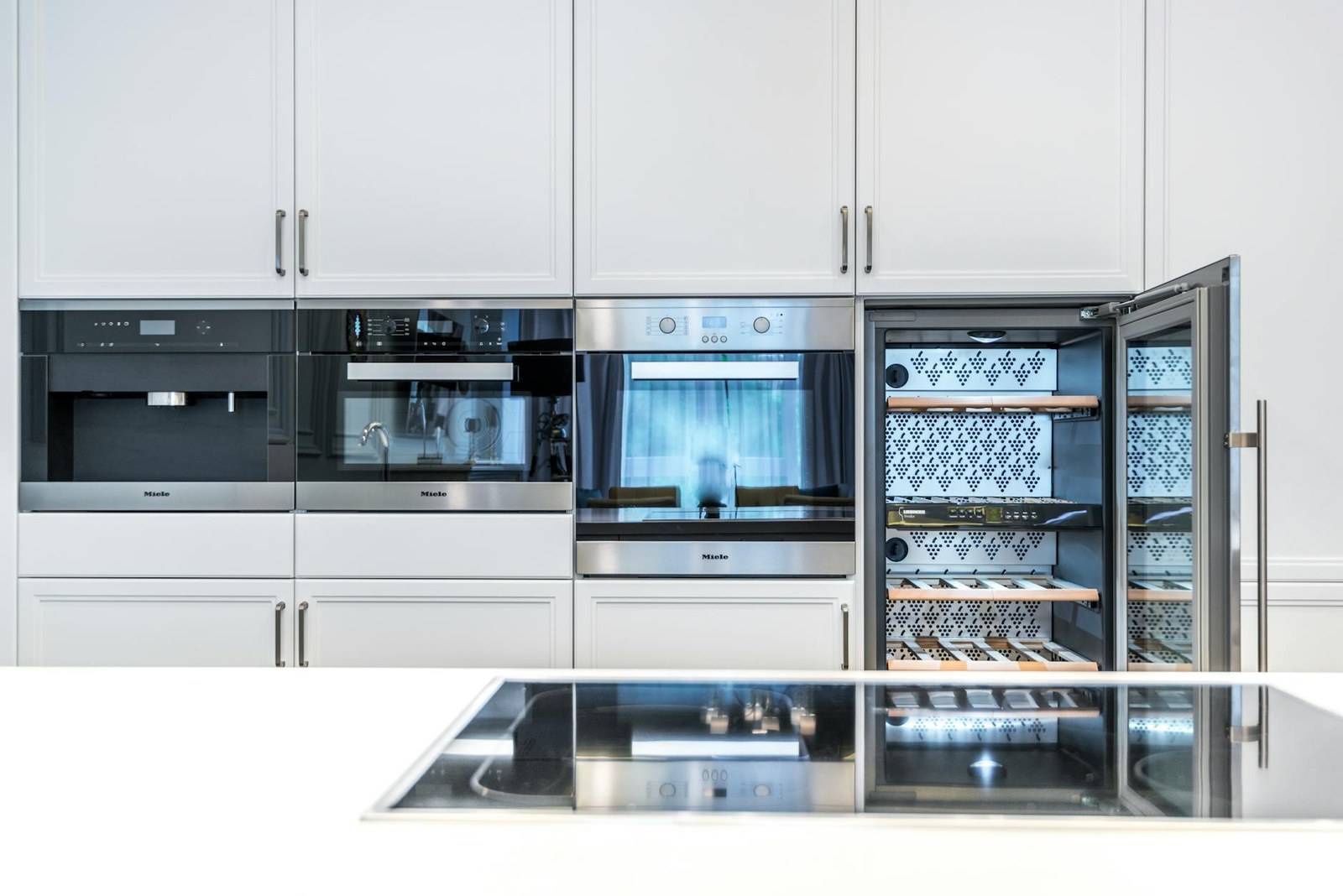
Integrated Appliances in an Adelaide Kitchen — Worth the Premium?
Integrated appliances — fridges, dishwashers, ovens and rangehoods that disappear behind matching cabinet doors — are one of the most visible “premium” decisions in a kitchen renovation, and one of the easiest to over-spend on. The premium per appliance over the equivalent freestanding model ranges from $300 to $4,500, with cabinet-build implications that add another $400 to $1,800 per integrated unit. Across a typical Adelaide kitchen that wants to be fully integrated — fridge, dishwasher, microwave, oven, rangehood — the total premium against freestanding can run from $3,500 to $14,000.
That premium pays back cleanly in some kitchens and is largely invisible in others. The deciding variable isn’t the kitchen — it’s the home it sits in. In premium-tier ($1.2m+) Adelaide stock where buyers expect integrated as standard, the premium recovers 80 to 110 percent at sale. In mid-range ($700k-$1.0m) stock, recovery drops to 50 to 80 percent. In sub-$700k stock, recovery rates fall to 30 to 60 percent — meaning the premium is largely a personal-taste cost rather than a value-add.
This guide is the calm calculation. What integrated actually means versus freestanding versus slot-in. The honest cost premium per appliance. The cabinet implications and service-access realities. Where integrated genuinely wins, where it’s vanity, and an Adelaide brand-pricing snapshot for 2026.
What “integrated” actually means
The term covers three different appliance types that look the same from outside the kitchen but build differently:
Fully integrated — appliance is invisible behind a cabinet door
The appliance has no visible front. A cabinet door (matching the rest of the kitchen) is hung on the appliance’s front panel using brackets supplied by the manufacturer. From two metres away, the kitchen reads as continuous cabinetry with no break for the appliance.
Common in: dishwashers, fridges, freezers, microwaves, wine cabinets.
Panel-ready (sometimes called “integrated front”)
The appliance has a custom cabinet door fitted onto a front panel that’s part of the appliance, but the appliance brand and visible controls (temperature, dial, screen) remain on a top edge or upper trim. Less invisible than fully integrated, cheaper than fully integrated, more durable.
Common in: high-end fridges and freezers (Sub-Zero, Liebherr).
Built-in (slot-in)
The appliance has a finished front (typically stainless or coloured glass) but is sized to slot cleanly into a cabinet void with no surrounding gap. Reads as visible appliance integrated into the cabinetry, rather than concealed.
Common in: ovens (where most Adelaide kitchens use built-in 600mm ovens), microwaves, induction cooktops.
The cost-and-impact ranking from cheapest to most premium:
- Freestanding — cheapest, visible appliance, easy to swap.
- Built-in — mid-priced, looks built-in, replaceable.
- Panel-ready — expensive, partly concealed, custom door.
- Fully integrated — most expensive, fully concealed, custom door.
Each step up the ladder adds cost in two places: the appliance itself, and the cabinetry that hosts it.
Cost premium per appliance — Adelaide 2026
The numbers below are 2026 retail snapshots from major Adelaide appliance retailers, comparing equivalent specs at the freestanding and integrated levels. Pricing fluctuates with brand, model and time of year.
Dishwasher — the easiest integration
| Spec | Freestanding | Integrated front | Fully integrated |
|---|---|---|---|
| Mid-tier (Bosch, Miele entry, Beko) | $700 - $1,200 | $1,000 - $1,500 | $1,200 - $1,800 |
| Premium (Miele, Asko, Smeg) | $1,400 - $2,500 | $1,800 - $3,200 | $2,200 - $3,800 |
| Cabinet-build cost (custom door + panel + bracketry) | $0 | $250 - $400 | $400 - $700 |
Integrated dishwasher premium over equivalent freestanding: typically $500 to $1,400 all-in.
The dishwasher is the cleanest integration in any kitchen — small footprint, simple plumbing, no thermal complexity. Recovery rate at sale (above $1m stock): 100 to 130 percent. The single best value integration in a kitchen renovation.
Fridge and freezer — the largest premium
| Spec | Freestanding | Built-in | Panel-ready | Fully integrated |
|---|---|---|---|---|
| Mid-tier French-door (LG, Samsung, Westinghouse) | $1,800 - $3,500 | not standard | not standard | rare |
| Premium French-door (Fisher Paykel, Smeg) | $3,500 - $6,500 | $5,500 - $9,500 | $7,500 - $12,000 | $9,500 - $16,000 |
| Luxury (Sub-Zero, Liebherr Monolith) | not applicable | $10,000 - $15,000 | $14,000 - $22,000 | $18,000 - $32,000 |
| Cabinet-build cost (custom doors + cabinet wrap + panel) | $0 | $400 - $800 | $1,200 - $2,200 | $1,800 - $3,500 |
Integrated fridge premium over equivalent freestanding: typically $4,000 to $9,000 all-in for premium brands; $14,000+ for luxury.
The fridge is the highest-cost integration and the highest-impact visually. A fully integrated fridge in an open-plan kitchen reads as continuous cabinetry — the visual weight of the kitchen drops significantly. Recovery rate at sale (above $1.2m stock): 70 to 100 percent.
Oven — the easiest “looks integrated” outcome
| Spec | Freestanding 900mm | Built-in 600mm | Built-in 750mm |
|---|---|---|---|
| Mid-tier (Westinghouse, Beko) | $1,200 - $2,200 | $900 - $1,800 | $1,400 - $2,500 |
| Premium (Bosch, Smeg, Miele entry) | $2,500 - $4,500 | $1,800 - $3,500 | $2,800 - $5,500 |
| Luxury (Wolf, V-Zug, Miele top) | $5,500 - $12,000 | $5,500 - $14,000 | $8,000 - $18,000 |
| Cabinet-build cost (oven cabinet, ventilation, surround) | $0 | $200 - $500 | $300 - $700 |
Built-in oven premium over equivalent freestanding: small to negligible. Built-in is the standard install in custom Adelaide kitchens — the cost difference is typically inside the cabinet-build margin and isn’t a meaningful upcharge.
The “freestanding 900mm range cooker” trend in Hamptons and French Provincial kitchens runs against the built-in trend — and it pays back beautifully in those style guides. Read the Hamptons style guide for context.
Rangehood — concealed vs visible
| Spec | Visible (canopy or undermount) | Concealed (built into cabinet) | Downdraft (in-bench) |
|---|---|---|---|
| Mid-tier | $400 - $1,000 | $600 - $1,400 | $1,800 - $3,500 |
| Premium | $1,200 - $2,500 | $1,500 - $3,500 | $3,500 - $6,500 |
| Cabinet-build cost | $0 | $300 - $700 (custom cabinet door) | $700 - $1,500 (in-bench mounting) |
Concealed rangehood premium: typically $300 to $1,500 over visible.
The concealed rangehood — built into a custom cabinet with the suction zone and ducting hidden — is one of the cleanest visual upgrades in a contemporary kitchen. Pays back well in mid-to-premium stock.
Microwave — small premium, small impact
| Spec | Freestanding (countertop) | Built-in (cabinet trim) | Drawer microwave (in-bench) |
|---|---|---|---|
| Mid-tier | $200 - $500 | $400 - $900 | $1,200 - $2,500 |
| Premium | $600 - $1,200 | $900 - $1,800 | $1,800 - $3,500 |
Built-in microwave premium over freestanding: $200 to $700.
The built-in microwave (typically above the oven in an oven tower) is a standard Adelaide custom-kitchen build. Cost is small; impact is modest — most buyers don’t notice whether the microwave is built-in or not.
Cooktop — induction vs gas vs electric
| Spec | Mid-tier 60cm | Premium 90cm | Luxury 90cm |
|---|---|---|---|
| Gas | $700 - $1,400 | $1,400 - $2,800 | $3,500 - $7,000 |
| Electric (ceramic) | $500 - $1,000 | $900 - $1,800 | $2,500 - $5,000 |
| Induction | $1,200 - $2,200 | $2,200 - $4,500 | $5,500 - $11,000 |
| Cabinet-build cost | $0 - $200 | $200 - $500 | $400 - $900 |
Induction premium over equivalent gas: typically $400 to $2,000 per cooktop.
Induction in 2026 is the increasingly default choice in Adelaide custom kitchens — better thermal efficiency, easier cleaning, no open flame, and electric appliances align with the broader Australian electrification trend. The premium is real but recovers well in mid-to-premium stock.
Cabinet-build implications — what your builder needs to know
Integrated appliances aren’t just a more expensive box; they change the cabinetry build in specific ways:
Custom door fronts that match the cabinetry
Each integrated appliance needs a custom door panel cut, finished and edged to match the surrounding cabinetry. The custom-door cost is $200 to $700 per panel for two-pack or thermofoil; $500 to $1,500 for premium timber veneer.
Cabinet voids sized exactly to appliance dimensions
Integrated appliances have tighter fitting tolerances than freestanding (which sit in 600mm cabinet voids regardless of the actual appliance). Integrated voids need to match the appliance’s exact dimensions — a 5mm error and the door doesn’t sit flush. Mid-renovation appliance changes (where the new appliance dimensions differ from the original spec) can require cabinet rework that adds $400 to $1,800 per appliance.
Ventilation and thermal clearances
Integrated fridges and freezers need ventilation paths into the cabinet. The cabinet build needs a perforated kicker at the bottom and a vented panel at the top. Integrated ovens need a heat-clearance allowance above and beside.
Where the cabinet build doesn’t allow for ventilation, integrated appliances run hot and fail early. Fridges in particular — a poorly-ventilated integrated fridge has 60 to 80 percent of the operating life of the same fridge in a ventilated cabinet. The fridge cost premium pays for itself only if the cabinetry hosts it correctly.
Plumbing and electrical access
Most integrated appliances need rear access for plumbing, electrical or condensation drainage. The cabinet build needs to leave service access — typically a removable rear panel or a slot in the cabinet base. Without service access, repairs require the cabinet to be physically removed.
Servicing and replacement realities
Integrated appliances are harder to service than freestanding. The technician has to remove the cabinet door, disconnect the bracket, slide the appliance out, repair, and reverse the process. Service callouts on integrated appliances cost 20 to 40 percent more than the same callout on freestanding.
When the appliance reaches end-of-life, replacement is constrained by the cabinet void’s exact dimensions. If the original spec is no longer available, you may need to source a replacement that matches dimensions — which can mean compromising on spec or rebuilding the cabinet.
When integrated wins
The conditions where integrated genuinely pays back, in calm priority order:
Premium-tier homes ($1.2m+) where buyers expect it
In Adelaide premium stock — Burnside, Tusmore, Hyde Park, Glen Osmond, Glenelg-South, Mount Lofty — integrated appliances are now expected as standard rather than premium. A non-integrated fridge in a $1.5m home reads as “kitchen not finished”. The integration premium recovers cleanly.
Open-plan kitchens
In open-plan layouts, the kitchen is visible from the living and dining areas. Visible appliances — particularly large ones like fridges — read as visual weight. Integrating them recovers the visual cleanness of the layout. Closed-plan (separate kitchen room) kitchens lose less from visible appliances.
Premium custom cabinetry that matches the integration
If you’re spending on premium custom timber-veneer or two-pack cabinetry, the cost-per-unit-quality of integration is small relative to the cabinetry premium. Visible freestanding appliances against premium cabinetry create a visual mismatch that undercuts the cabinetry investment.
Long-term ownership where the integration matters daily
The “kitchen looks finished” feeling is a daily quality-of-life upgrade. Owners staying 10+ years feel the integration premium more than owners on shorter horizons. The dollar cost per year of ownership equalises the longer you stay.
When freestanding still wins
The mirror image. Freestanding appliances are the better buy when:
The home is in a sub-$900k segment
Buyers in this segment don’t pay premium for integration. The premium spent on integration in sub-$900k stock is largely lost at sale. Freestanding mid-tier appliances in this segment recover their cost cleanly and look fine in listing photography.
The kitchen is small or budget-constrained
In a small or budget kitchen, the integration premium ($3,500 to $14,000 across full integration) is a meaningful share of the renovation budget. Spend it on cabinetry build quality or on the bench-top instead — both recover better at sale than integration in the same segment. Read the small kitchen renovation guide for the budget framework.
The owner cooks heavily
Freestanding ovens have larger cavities, more powerful elements and better ventilation than equivalent built-in units. Heavy cooks often prefer freestanding 900mm range cookers (especially in Hamptons or French Provincial style kitchens) for the cooking performance, not the visual concealment.
The appliance lifecycle is shorter than the cabinetry
Most owners replace ovens every 8 to 15 years and dishwashers every 7 to 12. Cabinetry life is 18 to 25 years. Integrated appliances tied to cabinet voids constrain future appliance choices to dimensions that match. Freestanding gives you flexibility on the next appliance cycle.
Service and repair access matters
Older homes with limited cabinet-rear access (heritage stock, small footprints, slab-on-ground builds with no under-floor space) make integrated servicing genuinely difficult. Freestanding is the practical choice in these homes.
Adelaide brand pricing snapshot (2026)
The brands most commonly specified in Adelaide custom kitchens, ranked by typical retail and integration support:
Mid-tier (most common Adelaide spec)
- Bosch — strong on dishwashers and built-in ovens. Reliable, well-priced, broad availability. Service network in Adelaide is good.
- Westinghouse / Electrolux — Australian-made historically, strong on freestanding and budget-built-in. Service is solid.
- Smeg — Italian style, reasonable pricing, strong on retro-style range cookers. Service and parts availability slower than Bosch.
- Miele entry-level (G-series dishwashers, H-series ovens) — premium build at mid-tier pricing. Strong residual value at sale.
Premium (band 3 stock spec)
- Miele full range — the default Adelaide premium choice. Long warranties, excellent service network.
- Asko — Scandinavian, strong on dishwashers and laundry. Premium build, mid-spec pricing for the build quality.
- Fisher Paykel — Australian-made, strong on integrated fridges and dish drawers (the “DishDrawer” is widely specified in butler’s pantries). Read the butler’s pantry design ideas.
Luxury (band 4 stock spec)
- V-Zug — Swiss-made, very high build quality, premium pricing. Strong choice in eastern-suburbs band 4 builds.
- Wolf and Sub-Zero — American, statement appliances. Wolf for cooking, Sub-Zero for cold storage. Premium pricing, strong residual at sale in luxury stock.
- Liebherr — German, integrated fridges and freezers at the top of the market. Common in luxury custom kitchens with butler’s pantries.
A 7-appliance Adelaide kitchen comparison
For a 7-appliance Adelaide kitchen (oven, cooktop, rangehood, dishwasher, fridge, microwave, sink — sink and tapware aren’t appliances but feature in the same budget):
| Spec | Freestanding | Mid-tier integrated | Premium integrated |
|---|---|---|---|
| Oven | $1,400 (Bosch built-in) | $1,400 (Bosch built-in) | $4,500 (Miele) |
| Cooktop | $1,200 (Westinghouse gas) | $1,800 (Bosch induction) | $3,500 (Miele induction) |
| Rangehood | $700 (canopy) | $1,200 (concealed) | $2,500 (concealed Miele) |
| Dishwasher | $900 (Bosch freestanding) | $1,400 (Bosch integrated) | $2,800 (Miele integrated) |
| Fridge | $2,500 (LG French-door FS) | $4,500 (Fisher Paykel built-in) | $14,000 (Liebherr integrated) |
| Microwave | $400 (countertop) | $700 (built-in) | $1,400 (Miele built-in) |
| Sink/tapware | $1,000 | $1,200 | $2,500 |
| Subtotal — appliances | $8,100 | $12,200 | $31,200 |
| Cabinet integration premium | $0 | $1,800 - $2,800 | $4,500 - $7,500 |
| Total | $8,100 | $14,000 - $15,000 | $35,700 - $38,700 |
The mid-tier-integrated option is the sweet spot for most Adelaide owner-occupier homes in band 2 and 3. The premium-integrated option fits band 4 luxury stock. The freestanding option fits band 1 refresh and rental upgrades.
How to brief integrated appliances
If you’re going integrated, brief the choice clearly into the renovation contract from day one. The brief needs to specify:
- Which appliances are integrated (fridge, dishwasher, microwave, rangehood, etc.) and at which level (built-in, panel-ready, fully integrated).
- The exact appliance brands and models — not “premium dishwasher” but “Miele G7100SCi integrated”.
- Who’s supplying the appliances — owner-supplied or contractor-supplied.
- The cabinet-build allowances for ventilation, service access and door brackets.
- Confirmation that appliance specs are locked before cabinetry production starts. Mid-build appliance changes are expensive.
Don’t agree to “we’ll work it out at install” on integrated spec. Cabinet voids are built to spec; mid-build appliance changes can cost $1,800 to $4,500 per appliance to rework. Read how to find a renovation contractor you can trust — clear scoping on integrated appliances is one of the test questions for a good contractor.
Coordinating other trades around the renovation
Two adjacent jobs that pay back when timed with the kitchen install:
- Window cleaning and prep before listing photography or the final reveal. New integrated cabinetry against streaky kitchen-wall windows undermines the visual lift. Residential window cleaning in Adelaide handles glazing once the install is complete.
- End-of-build pest treatment. Integrated appliances create voids and access points that can be ant or rodent harbourage in older Adelaide stock. A treatment between cabinet install and appliance fitting seals the voids before they’re closed up. Adelaide pest control handles a single-visit treatment.
The honest answer on whether to integrate
Integration is a premium-tier decision that recovers cleanly in premium stock and loses money in mid-range stock. In sub-$900k Adelaide homes, freestanding mid-tier appliances are the right choice — the integration premium is wasted on a buyer base that doesn’t pay for it. In $1.2m-plus stock, integration is no longer a premium choice; it’s the standard the market expects, and skipping it costs more in lost listing premium than the integration premium itself.
The middle band ($900k-$1.2m) is the genuine question. Here, partial integration (dishwasher, microwave, rangehood concealed; fridge freestanding; oven built-in) is often the smart compromise. The integration premium stays manageable, the kitchen reads as finished, and the freestanding fridge keeps replacement flexibility.
Brief Kitchen Fox → for an integration-specific quote, or read the renovation cost guide for the wider budget framework.
Frequently asked questions
What’s the cost premium for integrated appliances in an Adelaide kitchen?
Across a fully integrated kitchen (fridge, dishwasher, microwave, oven, rangehood) the total premium against equivalent freestanding is typically $3,500 to $14,000, depending on brand tier and the cabinet-build implications.
Are integrated appliances worth it for resale?
Above $1.2m stock, yes — the recovery rate is 80 to 110 percent and integration is now expected. Below $900k, the recovery drops to 30 to 60 percent and the premium is largely a personal-taste cost. Read the renovation ROI analysis for suburb-specific numbers.
Do integrated fridges last as long as freestanding?
Sometimes yes, sometimes no. A well-ventilated integrated fridge has comparable life to freestanding. A poorly-ventilated integrated fridge has 60 to 80 percent of the operating life of equivalent freestanding. The ventilation in the cabinet build matters more than the appliance itself.
Can I service an integrated dishwasher easily?
Service is harder than freestanding by 20 to 40 percent in time and cost, but not impossible. The technician removes the cabinet door, disconnects the bracket, slides the appliance out for service, then reverses the process. Most service centres in Adelaide are familiar with the process.
What’s the most cost-effective integration?
The dishwasher. Premium of $500 to $1,400 over equivalent freestanding, recovery rate 100 to 130 percent in mid-to-premium stock, simple cabinet-build, easy servicing. Best single-integration value in a kitchen renovation.
What’s the least cost-effective integration?
A luxury-brand fully integrated fridge in mid-range stock. The premium of $14,000+ over a freestanding alternative recovers under 50 percent in $700k-$1.0m suburbs. Integrate the dishwasher and concealed rangehood; keep the fridge freestanding in this segment.
Should I integrate appliances in the butler’s pantry?
Generally no. The butler’s pantry is back-of-house — the visual benefit of integration is lost. A freestanding stainless dishwasher and second freestanding fridge in the butler’s pantry is the right spec. Read the butler’s pantry design guide.
Is induction a “integration” cost?
No — induction cooktops are a built-in install regardless. The cost premium for induction over gas or electric is about cooking technology, not visual integration. Induction is increasingly the standard in Adelaide custom kitchens for thermal efficiency and easier cleaning, separate from the integration question.