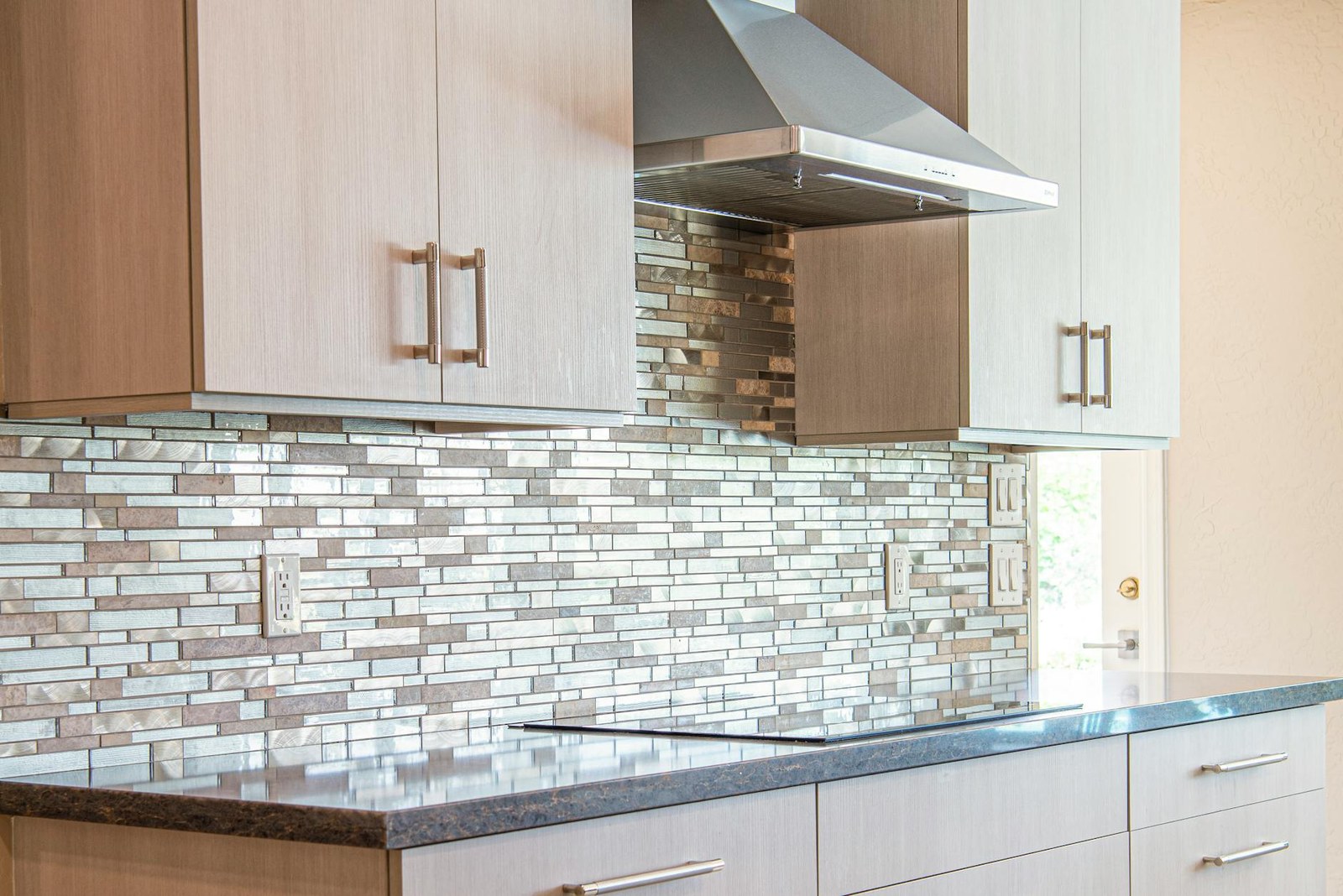
Kitchen Splashback Materials — Glass, Tile, Stone, Mirror, Tin
A splashback is the most visually loaded surface in a kitchen — it sits at eye level along the cooking wall, behind the range and under the upper cabinetry, where every drop of oil, splatter and scorch ends up. The material choice affects the visual register of the whole kitchen, the cost band of the renovation, the cleaning routine over 10-20 years of use, and the safety performance behind a gas cooktop. This guide walks the five main contenders — glass, tile, stone, mirror, pressed tin — with current Adelaide pricing, the install reality of each, the heat-rating constraints behind cooktops, and where each one earns its keep in a 2026 kitchen.
There is no single “best” splashback material. The right choice is a function of the kitchen’s visual style, the cooktop type (gas, induction, electric), the budget band, and the surrounding bench and cabinetry choices. We brief these constraints at consultation; this is the public version.
What a splashback actually does
Three jobs:
- Protect the wall. Cooking generates oil splatter, water splash, food debris and steam. The wall behind the cooktop and sink would degrade fast without a wipeable surface. The splashback is the wipeable surface.
- Set the visual register. A splashback is a 600-1,200mm-tall band that runs the full length of the cooking wall — typically 3-5 metres. It’s the largest single visual element in the kitchen after the cabinetry. Material choice tilts the kitchen toward modern (glass), traditional (subway tile), heritage (pressed tin) or premium (full-height stone).
- Comply with cooktop clearance. Behind a gas cooktop, the splashback material must meet AS/NZS 5601 gas-installation standards for non-combustible surface and minimum clearance from the burner to combustible material. Behind induction or electric, clearance requirements are less strict but heat-tolerance still matters.
The five main contenders, at a glance
| Material | Cost installed (per sqm) | Heat behind cooktop | Joints / grout | Install time | Cleaning |
|---|---|---|---|---|---|
| Glass | $400-$900 | Excellent (toughened) | None (single sheet) | 2-3 weeks lead, 1 day install | Wipes clean, no grout |
| Tile (subway, mosaic) | $200-$600 | Excellent (ceramic/porcelain) | Grout joints | 2-4 days install | Wipe tile; grout requires periodic cleaning |
| Stone (slab) | $700-$1,800 | Excellent (porcelain/sintered); good (quartz, granite) | Mitre joints; minimal | 3-5 weeks lead, 1-2 days install | Wipes clean, sealing for some materials |
| Mirror | $500-$1,200 | Limited (heat distortion) — not behind gas cooktops | None | 2-3 weeks lead, 1 day install | Wipes clean; finger-marking |
| Pressed tin | $400-$1,000 | Limited (depending on substrate); usually with toughened glass overlay behind cooktop | Panel joints visible | 2-3 weeks lead, 1-2 days install | Wipe panels; vintage finish hides marks |
Pricing reflects Adelaide 2026 supply-and-install. Excludes wall preparation, plaster repair and electrical relocations.
Glass splashbacks
Toughened glass, typically 6-8mm thick, painted on the back face in any colour. The classic modern splashback choice.
How it works
Glass is supplied as a single sheet or two-three joined sheets cut to the wall dimension. The back face is painted in the chosen colour (any RAL or custom colour) and the painted face is sealed before install. Glass is mounted to the wall with structural silicone adhesive, with cut-outs templated for power points and rangehood.
Toughened glass is non-combustible and rated for direct cooktop heat exposure. Glass colour is uniform and consistent — no batching variation, no grout lines, no surface texture.
Strengths
- Non-combustible behind gas. Toughened glass is the cleanest gas-cooktop solution; meets AS/NZS 5601.
- No joints, no grout. Single-sheet install (or 2-3 sheet joins where the wall is too long for a single sheet) eliminates the cleaning grief of grouted joints.
- Colour flexibility. Any colour can be back-painted. Match the cabinetry, contrast with the bench, or pick a feature colour.
- Easy cleaning. Wipes clean with a standard kitchen surface spray. No re-grouting, no sealing.
Weaknesses
- Visible joins on long walls. A 5m+ run typically needs two or three sheets joined; the joins are visible at close range.
- Lead time. 2-3 weeks from template to install. Templating happens after cabinetry and benchtop are in.
- Cost. Mid-tier price point; cheaper than full stone but more expensive than mid-spec tile.
- Damage repair. A chipped or cracked sheet typically needs full replacement of that section, not a patch repair.
Cost in Adelaide 2026
- Standard back-painted glass, single colour: $400-$600 per sqm installed.
- Premium colours, custom finishes: $600-$900 per sqm installed.
- Patterned or printed glass (digital print to back face): $700-$1,200 per sqm installed.
Total cost for a typical 4m x 0.7m splashback (2.8 sqm): $1,200-$2,500.
Tile splashbacks
Ceramic or porcelain tile, in subway, herringbone, mosaic, or large-format formats. The traditional and budget-flexible choice.
Subway tile
The volume choice. 100x300mm or 75x150mm white or coloured ceramic tiles laid in offset (running-bond) or stack-bond patterns. Reads classic, Hamptons, modern-traditional.
- Cost installed: $200-$450 per sqm.
- Strengths: Cheapest tile option; widely available; classic visual register; matches Hamptons, Provincial and traditional kitchens.
- Weaknesses: Grout joints are 80-100 linear metres per typical splashback — significant grout-line cleaning over time. White grout discolours; epoxy grout helps but adds cost.
Herringbone and chevron
Subway tile laid in herringbone or chevron patterns. More design-led; common in modern and Hamptons kitchens.
- Cost installed: $300-$600 per sqm.
- Strengths: Visual interest; on-trend pattern; works in mid-tier and premium kitchens.
- Weaknesses: Higher install labour cost; more cuts and waste than straight subway lay.
Mosaic tiles
Smaller tiles (typically 25-75mm) on a mesh sheet. Includes hexagon, penny-round, square, fish-scale formats. Visual feature options.
- Cost installed: $400-$800 per sqm.
- Strengths: Strong visual register; hides minor wall variation; many colour and finish options.
- Weaknesses: Highest grout-line density; cleaning grief over time; smaller cuts at edges and around power points.
Large-format tiles
Tiles 600mm+ in any dimension. Reads modern, monolithic; minimal grout joints.
- Cost installed: $400-$900 per sqm depending on the tile material and finish.
- Strengths: Few grout joints; modern visual register; suits contemporary kitchens.
- Weaknesses: Tile breakage during cut and install (large pieces fail more often); needs an experienced tiler; lead time on premium tile imports.
Strengths of tile generally
- Widest range of styles, colours and price points of any splashback material.
- Behind gas — ceramic and porcelain are non-combustible and meet gas-clearance requirements.
- Repairable — individual tiles can be replaced if damaged.
- Long-lasting — tile splashbacks typically last 20-30 years before refresh.
Weaknesses of tile generally
- Grout-line cleaning is the biggest long-term cost. White grout discolours; epoxy grout helps but adds 30-50% to grout cost.
- Install labour ranges with pattern complexity. Mosaic and herringbone cost 2-3x straight subway in install time.
- Visual register can date — early-2000s travertine and beige tile splashbacks now read very dated.
Stone splashbacks
Either as a continuation of the benchtop material rising up the wall (a “splashback-and-bench in one”) or a separate stone slab spec. Premium spec.
Full-height stone splashback
The bench material continues up the wall to the underside of the upper cabinetry. Mitre-joined to the benchtop. Mid-tier and premium kitchens; reads luxury.
- Cost installed: $700-$1,800 per sqm depending on the stone (low-silica quartz, porcelain, sintered, marble, granite).
- Strengths: No grout, no joints (other than a single mitre at the bench junction); premium visual register; matches the benchtop directly; non-combustible.
- Weaknesses: Highest cost option; lead time tied to benchtop fabrication; mitre joint requires a skilled stonemason; replacement of a damaged section is non-trivial.
Stone tile splashback
Stone tiles (typically marble, travertine, or premium ceramic/porcelain in stone-look) laid like ceramic tile. Less seamless than slab but cheaper.
- Cost installed: $400-$800 per sqm.
- Strengths: Stone aesthetic at lower price than slab; many natural stone colour and veining options.
- Weaknesses: Grout joints; some natural stones (marble, travertine) need periodic sealing.
Strengths of stone splashbacks generally
- Premium visual register; communicates higher-tier kitchen.
- Direct material continuity with the benchtop creates a monolithic visual.
- Non-combustible behind gas.
- Long lifespan — porcelain and sintered stone are essentially permanent.
Weaknesses of stone splashbacks generally
- Cost is the highest of the five categories.
- Lead time on stone slab fabrication adds 2-4 weeks to the project.
- Some natural stones (marble) stain or etch from acidic spills (citrus, vinegar). Read our stone benchtops buyer’s guide for the material-specific maintenance.
- Engineered stone — see the regulatory caveat below.
Note on engineered stone
The Australian engineered-stone ban (1 July 2024) reshaped the engineered-stone splashback market. Pre-ban high-silica engineered stone is no longer manufactured or installed. Low-silica engineered stone, porcelain, and sintered stone are the current legal alternatives. Read our stone benchtops buyer’s guide for the regulatory context.
Mirror splashbacks
Single sheet of mirror glass, typically 6-8mm thick, mounted to the wall.
How it works
Mirror is supplied as a sheet (or two joined sheets) cut to the wall dimension. Mounted to the wall with structural adhesive. Behind a gas cooktop, mirror typically requires a heat-resistant interlayer or is replaced with toughened glass for that section.
Strengths
- Visual amplification. Reflects the kitchen, doubles perceived light, makes small kitchens feel larger.
- No joints, no grout. Single-sheet install (or two-sheet joined).
- Easy cleaning. Wipes clean with glass cleaner.
Weaknesses
- Heat distortion behind gas cooktops. Mirror is not heat-rated for direct gas-burner exposure. Behind gas, the splashback either uses toughened glass (not mirror) for the cooktop section, or the cooktop position is changed to allow a mirror sheet across the rest of the wall.
- Finger-marking. Mirror shows finger marks more visibly than coloured glass. Daily wipe required.
- Distortion in cheap mirror. Budget mirror sheets show optical distortion; spec premium 6mm+ mirror.
- Visual fatigue. Reflective surfaces can read busy in already-busy kitchens. Best in minimal kitchens.
Cost in Adelaide 2026
- Standard 6mm mirror splashback: $500-$900 per sqm installed.
- Antique or smoked mirror finish: $700-$1,200 per sqm installed.
Mirror splashback is best behind sinks and prep zones, with toughened glass or stone reserved for the cooktop section where heat-rating matters.
Pressed tin splashbacks
Pressed-metal tin panels in heritage and Federation patterns. A specialty choice.
How it works
Tin panels (typically 600x600mm) are pressed with traditional patterns (rosette, classic, fleur-de-lys). Mounted to the wall, sometimes covered with a toughened-glass overlay behind a gas cooktop. Suits Federation, Edwardian and Victorian-era heritage kitchens; less common in modern kitchens.
Strengths
- Heritage authenticity. Works in restoration projects; reads period-appropriate.
- Visual texture. Pattern detail at close range; reads richer than flat tile or glass.
- Repairable. Individual panels can be replaced if damaged.
Weaknesses
- Limited heat tolerance behind gas. Most tin panels need a toughened-glass overlay behind a gas cooktop for safety.
- Visible joints between panels. 600x600mm panels show edge-joint lines; not a seamless surface.
- Cleaning. Pressed pattern detail collects oil and dust; periodic deep clean needed.
- Style limitation. Heritage register only; does not suit modern kitchens.
Cost in Adelaide 2026
- Standard tin panel splashback: $400-$700 per sqm installed.
- Premium pattern, copper or brass finish: $700-$1,200 per sqm installed.
Joints, sealants and behind-cooktop heat ratings
Three install details that matter regardless of material:
Behind-gas-cooktop clearance
AS/NZS 5601 gas-installation standard requires a non-combustible surface within the gas-clearance zone (typically 200mm above the highest burner). All five splashback materials in this guide can meet this standard with the right spec — toughened glass, ceramic and porcelain tile, stone slab, and pressed tin with toughened-glass overlay all qualify. Mirror does not — behind gas, mirror needs to be replaced with toughened glass for the cooktop section.
Joints and silicone
The bench-to-splashback joint and the splashback-to-cabinetry joint take water and oil exposure. Silicone the joints with a colour-matched, mould-resistant silicone. Re-silicone every 5-10 years as the original silicone discolours and fails. White silicone yellows fastest; coloured silicones generally hold colour better.
Power points and rangehood cut-outs
Templating power points and the rangehood cut-out is the install detail most often missed. Power points typically need to be relocated 100-150mm above the bench (above splash zone). Rangehood cut-outs match the rangehood model exactly. Get the cut-out wrong and the splashback comes off the wall to be re-cut — a $1,500-$3,000 mistake.
Costs by material — typical Adelaide 4m x 0.7m splashback (2.8 sqm)
| Material | Low-band cost | Mid-band cost | Premium cost |
|---|---|---|---|
| Subway tile | $560 | $900 | $1,400 |
| Herringbone tile | $850 | $1,400 | $1,800 |
| Mosaic tile | $1,100 | $1,800 | $2,400 |
| Large-format tile | $1,100 | $1,800 | $2,500 |
| Glass (back-painted) | $1,100 | $1,700 | $2,500 |
| Mirror | $1,400 | $2,000 | $3,400 |
| Pressed tin | $1,100 | $1,700 | $3,400 |
| Stone tile | $1,100 | $1,700 | $2,200 |
| Stone slab (full-height) | $2,000 | $3,500 | $5,000+ |
Total cost includes supply, fabrication, install, silicone joints, basic wall preparation. Excludes power-point relocation, plaster repair beyond minor, and electrical work.
Choosing the right splashback for your kitchen
A decision sequence:
- What is the kitchen’s visual register? Modern minimalist — glass or large-format tile. Hamptons or traditional — subway tile or stone slab. Heritage — pressed tin. Premium luxury — full-height stone slab.
- What is the cooktop type? Gas — every option except mirror works directly; mirror needs toughened-glass section behind cooktop. Induction or electric — all options work.
- What is the budget band? Under $1,500 — subway tile or basic glass. $1,500-$2,500 — herringbone tile, mid-tier glass, mosaic. $2,500-$5,000 — large-format tile, stone tile, premium glass, mirror. $5,000+ — full-height stone slab.
- What is the cleaning tolerance? Low (zero grout) — glass, mirror, stone slab. Medium — pressed tin, large-format tile. High (regular grout cleaning) — mosaic, subway tile.
- What is the long-term plan? 10-15 years — most materials work. 20+ years — stone slab, glass, large-format porcelain. Replacement-friendly — tile (individual replacement easier).
Most Adelaide mid-tier kitchen renovations end up with glass or subway tile. Premium kitchens go to full-height stone or large-format porcelain. Heritage projects go to pressed tin or traditional subway. Read our kitchen renovation cost guide for the full project context.
Linking splashback to the rest of the kitchen
The splashback is one of three surface-and-finish decisions that interact:
- Bench surface — read stone benchtops buyer’s guide for the bench-material context. Many Adelaide kitchens run the bench material up the wall as the splashback (full-height stone splashback).
- Sink and tapware — read kitchen sinks and tapware buyer’s guide for the fixture-finish coordination. Tap finish (chrome, brushed nickel, matte black, brushed brass) should coordinate with the splashback finish.
- Lighting — read kitchen lighting design for under-cabinet LED strip context. Glass and mirror splashbacks reflect under-cabinet lighting more than tile or pressed tin; spec accordingly.
Frequently asked questions
What is the most popular kitchen splashback material in Adelaide?
Subway tile (white or coloured) and back-painted glass split the volume market. Subway tile dominates Hamptons and traditional Adelaide renovations; back-painted glass dominates modern kitchens. Premium kitchens increasingly choose full-height stone slab.
How much does a kitchen splashback cost in Adelaide?
For a typical 4m x 0.7m splashback (2.8 sqm), cost bands run from $600 (basic subway tile) to $5,000+ (premium full-height stone slab). Most mid-tier renovations land in the $1,200-$2,500 band.
Can I have a mirror splashback behind a gas cooktop?
Not directly. Mirror is not heat-rated for gas-cooktop exposure. The standard solution is to use toughened glass (not mirror) for the cooktop section, with mirror across the rest of the wall. Or change the cooktop position to allow a mirror sheet across the full wall.
Are tile splashbacks dated?
Subway and herringbone tile is currently in vogue and reads classic-modern. Mosaic tile in early-2000s travertine or beige reads dated. Mid-2010s mosaic in glass or marble can still work. The visual register depends more on the tile choice than on the format itself.
How long does a glass splashback take to install?
2-3 weeks from final wall measurement to install. Templating happens after cabinetry and bench are in. The on-site install itself is typically 1 day.
Can I have a splashback that matches my benchtop?
Yes — full-height stone splashback runs the bench material up the wall to the underside of the upper cabinetry, mitre-joined at the bench junction. Premium spec; cost band $2,000-$5,000+ for a typical run.
What is the easiest splashback to clean?
Glass (back-painted or mirror) and stone slab — no grout joints, wipe clean. Tile is more cleaning work because of grout lines. Pressed tin sits between (panel joints, but no grout).
What is the most common splashback regret?
Choosing white or pale grout in mosaic or subway tile — the grout discolours over 5-10 years and is difficult to restore. Specify epoxy grout or a darker grout colour at the install stage.
Get a free splashback quote — or read our kitchen renovation cost guide for the full project context.